
I’ve been around packaging lines Industy for over a decade. And if there’s one question I keep hearing, it’s this: “VFFS or HFFS — which one do I actually pick?“
Here’s the honest answer. It depends. But probably not the way you think. VFFS (vertical form fill seal) and HFFS (horizontal form fill seal) are two different worlds — and most buyers pick wrong because they compare the wrong things.
Most blogs will give you a generic checklist. I’m going to walk you through what I’ve learned the hard way — so you don’t have to make the same mistakes.
Try Lintyco Machine Selector to get the best suitable machine now.
How Do These Machines Actually Work?
Comparing vffs packaging machines? Calculate your cost, then get a personalized recommendation.
Calculate Cost & Find the Right VFFS Machine →Two machines. Two completely different philosophies. Let’s break them down.
How a VFFS Machine Works (The Gravity Drop)
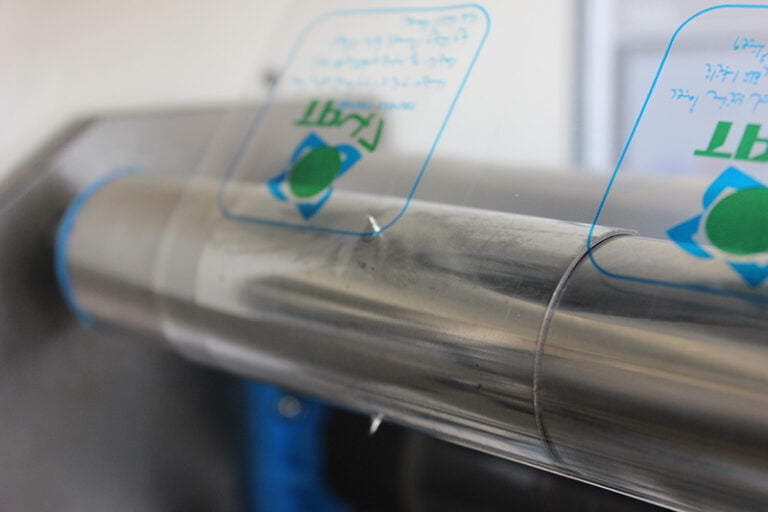
Imagine a tube. Film rolls off a spool, wraps around that tube, and seals into a cylinder. Product drops through the middle. Then seal bars pinch the bottom and top at the same time.
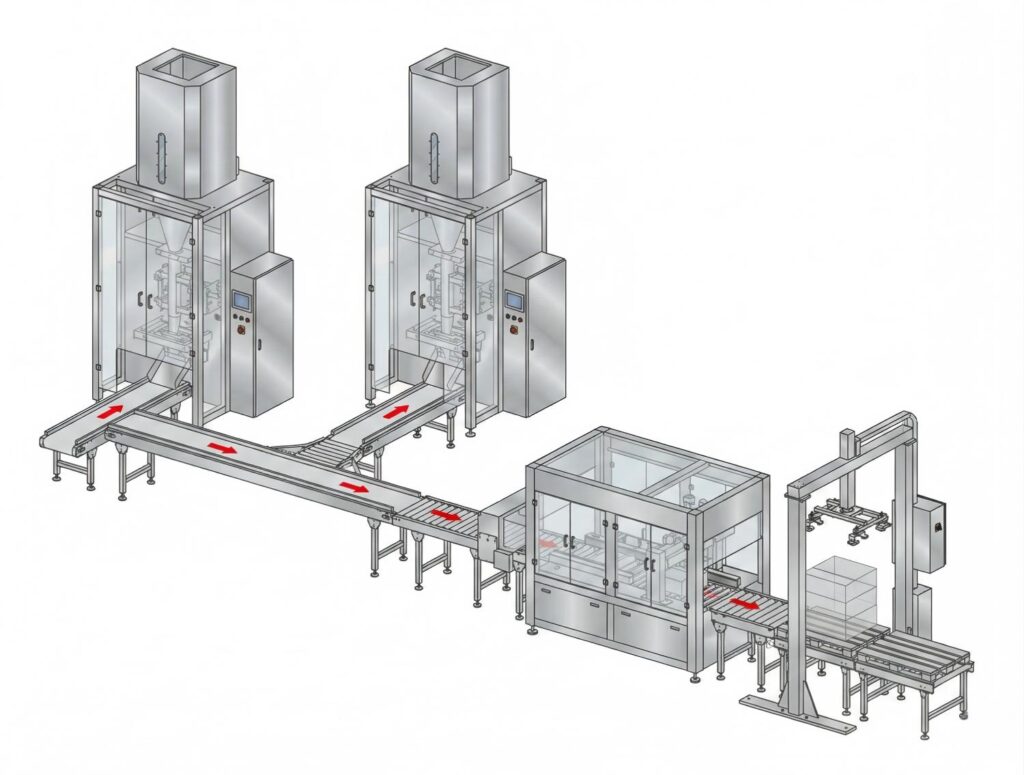
I call it the “fill from the sky” approach. Gravity does the heavy lifting — and honestly, gravity is pretty reliable.
Three steps, all vertical:
- Form — flat film gets pulled over a forming collar, becomes a tube
- Fill — product drops through the tube from a weigher or auger
- Seal — bars crimp the top of one bag and the bottom of the next. At the same time
Everything moves down. Product, film, the whole deal.
How a Horizontal Machine Works (The Conveyor Wrap)
This one’s a different animal. Products ride a conveyor like passengers on a bus. Film wraps around them as they go.
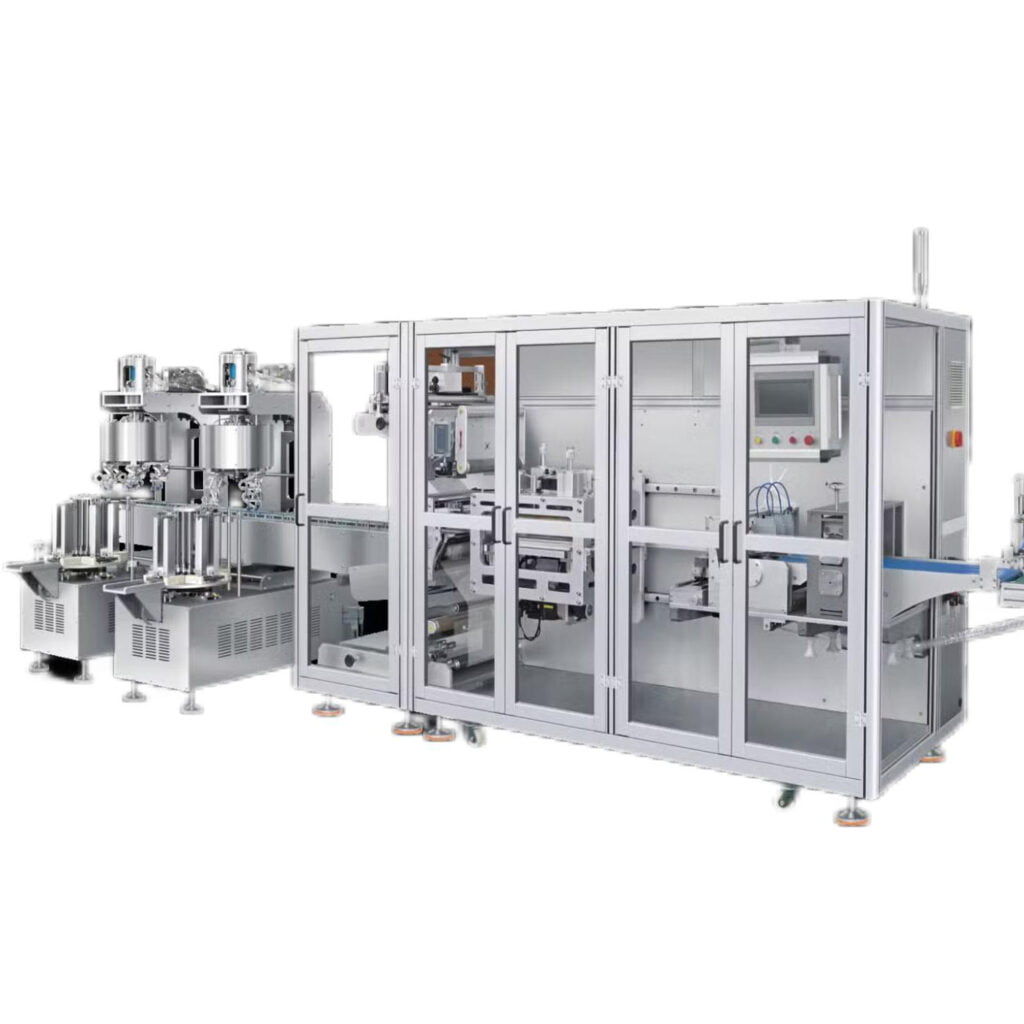
Steps are straightforward:
- Film feed — roll unwinds, forms a tube around the product
- Product infeed — items get placed on a conveyor, carried into the film tube
- End sealing — rotary sealors close the film at both ends
Film and product move forward together. Side by side.
Quick Comparison
| Aspect | VFFS | Horizontal |
|---|---|---|
| Film direction | Top → bottom | Left → right |
| Product feed | Gravity drop | Conveyor |
| Bag formation | Forming collar | Forming box |
| Seals | Horizontal cross-seals | Longitudinal + end seals |
| Package shape | Bags, pouches, sachets | Wrapped packs, trays, bars |
What Product Are You Packing?
This is the question that makes or breaks your decision. I’ve watched companies buy the wrong machine — and regret it for years.
You’d be surprised how often it happens. A snack company tries to run granola bars on a VFFS. A bakery forces bread through a flow wrapper designed for biscuits. It never ends well.
Try Lintyco Machine Selector to get the best suitable machine now.
When VFFS Is the Right Call
| Product Category | Examples | Why |
|---|---|---|
| Granular products | Rice, sugar, coffee beans, pet food | Gravity feeds naturally. No conveyor needed |
| Powder products | Flour, milk powder, spices | Auger filler screws right into the tube |
| Snack foods | Chips, nuts, popcorn | Multihead weigher drops from above. Fast |
| Frozen foods | Veggies, fries | Weigher doses without jamming |
| Liquids and pastes | Sauces, oils, shampoo | Pump shoots straight down |
When Horizontal Is the Right Call
| Product Category | Examples | Why |
|---|---|---|
| Bakery products | Biscuits, cookies, crackers | Flat items glide on conveyor |
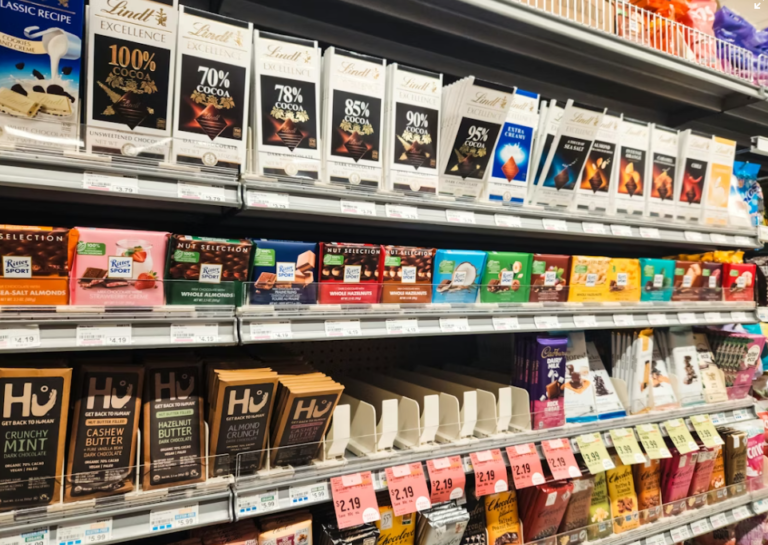
| Chocolate and confectionery | Bars, pralines, truffles | Regular shapes feed smoothly |
| Tray-packed items | Ready meals, produce on trays | Tray sits still, film wraps around |
| Pharma and medical | Blister packs, boxes | Gentle handling. Precise spacing |
| Multi-item packs | Multipack biscuits, stacked wafers | Group first, wrap together |
The Gray Zone
Some products can work on both. Here’s how I’d call them:
| Product | VFFS | Horizontal | Better Pick |
|---|---|---|---|
| Bread loaves | Awkward but possible | Fits like a glove | Horizontal |
| Ground coffee | Natural (auger) | Possible but complex | VFFS |
| Candy bars | Needs special feed | Fits naturally | Horizontal |
| Loose produce | Weigher works great | Not suited | VFFS |
| Block cheese | Possible with mods | Works perfectly | Horizontal |
Speed: Who’s Actually Faster?
Let’s get real about speed. The numbers tell one story. Reality tells another.
| Speed | VFFS | Horizontal |
|---|---|---|
| Low | 20–40/min | 30–80/min |
| Medium | 40–80/min | 80–200/min |
| High | 80–150/min | 200–500/min |
| Ultra | 150–300/min (multi-lane) | 500–800/min |
For comparable products, HFFS machines offer faster speeds, but VFFS offers the best value for money. There’s no single best option, only the one that best suits your needs.
Here’s What the Table Doesn’t Tell You
Speed isn’t just about the machine. It’s about your product.
VFFS flies with free-flowing granules. Sticky powders? You’ll be waiting. Horizontal screams with uniform biscuits. Odd shapes? Slows way down.
Multi-lane VFFS is the wild card — 4 lanes at 60 bags/min each gets you 240 bags/min total. Not bad at all.
At Interpack 2026, I watched Schubert’s TLM hit 800 packs/min for biscuits. And TNA’s robag Quantum did 300 bags/min per tube on VFFS. Impressive numbers — but they only matter if your product fits the machine.
Point is: don’t compare specs in a vacuum. Compare specs against your product.
What You’ll Actually Spend
Equipment Cost (Mid-Range Systems)
| Component | VFFS Line | Horizontal Line |
|---|---|---|
| Packaging machine | $15K–35K | $25K–70K |
| Feeding system | $8K–25K | $5K–15K |
| Conveyor | $2K–5K | $3K–8K |
| Check weigher | $3K–8K | $3K–8K |
| Complete line | $28K–73K | $36K–101K |
VFFS is cheaper. Not by a little — by a lot. That difference matters when you’re building a line from scratch.
Operating Costs
| Factor | VFFS | Horizontal |
|---|---|---|
| Film waste | 3–5% | 2–4% |
| Changeover time | 20–40 min | 15–30 min |
| Maintenance | Moderate | Moderate to high |
| Spare parts | Lower | Higher |
More moving parts on horizontal machines means more to break. Something to keep in mind.
Check out the Lintyco cost calculator and save tens of thousands of dollars annually.

Package Types: What Can You Actually Make?
VFFS Formats
| Format | Looks Like | Used For |
|---|---|---|
| Pillow bag | Classic pouch | Snacks, rice, coffee |
| Gusseted bag | Side folds = more room | Pet food, flour |
| Flat bottom bag | Stands on shelf | Premium coffee, nuts |
| Quad seal bag | Four sealed corners | Coffee, pet food |
| Stick pack | Thin single-serve | Sugar, instant coffee |
| Sachet | Tiny flat pouch | Sauce, ketchup |
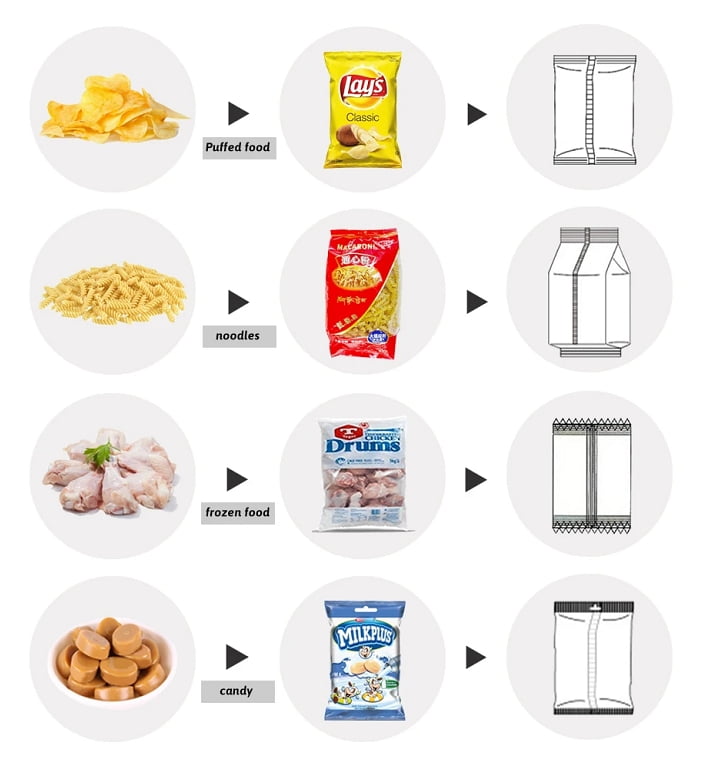
Horizontal Formats
| Format | Looks Like | Used For |
|---|---|---|
| Flow wrap | Film around product | Biscuits, bars, trays |
| Fin seal | Sealed on both sides | Chocolate bars |
| Lap seal | Overlap seal on bottom | Bakery, sweets |
| Shrink wrap | Film shrinks tight | Multipacks, trays |
Here’s my honest take. VFFS gives you more packaging options. Swap the forming set, change the seal bars — you get a different bag. Horizontal machines are more specialized. A flow wrapper built for biscuits won’t wrap trays without major rework.
PPWR Compliance: Can Both Systems Handle It?
Short answer: yes. But there are differences worth noting.
| Requirement | VFFS | Horizontal |
|---|---|---|
| Mono-PE/PP films | Yes | Yes |
| Thin films (15–30 μm) | Yes (ultrasonic seal) | Yes |
| Compostable films | Yes (PLA/PBAT) | Yes |
| Paper-based wrapping | Limited | More established |
| QR code printing | Yes (inline printer) | Yes |
Here’s the thing. Horizontal handles paper-based wrapping better — the horizontal film path doesn’t fight stiff paper. VFFS vertical collars? They struggle with paper. But VFFS handles thin mono-materials better — gravity feed reduces film tension.
Quick Decision Matrix
| Your Product | Pick This | Why |
|---|---|---|
| Free-flowing granules/powders | VFFS | Gravity feeds naturally. Fast. Accurate |
| Solid, flat, regular shape | Horizontal | Conveyor feeding is efficient |
| Need multiple bag formats | VFFS | Swap tooling, get new bags |
| Speed over 200/min | Horizontal | Higher ceiling |
| Budget under $50K | VFFS | Cheaper entry point |
| Trays or multipacks | Horizontal | Products sit on conveyor |
| Loose fresh produce | VFFS | Weigher integration |
| Premium stand-up pouches | VFFS | Flat bottom capability |
| Biscuits or chocolate bars | Horizontal | Standard application |
| Liquids or pastes | VFFS | Pump filler from above |
Questions I Actually Get Asked
Can a VFFS Machine Handle Solid Products?
You can make it work. Use vibrating channels or bucket elevators. But should you? If you’re packaging biscuits or bars — go horizontal. Less headache. Trust me on this.
What About Powders on a Horizontal Machine?
Don’t do it. Powders spill everywhere on a horizontal feed path. For powders, you want a VFFS with an auger filler. That’s the industry standard for a reason.
Which One Costs More to Maintain?
Horizontal machines. More parts, more complexity. VFFS machines are mechanically simpler. Fewer things to go wrong.
How Does Film Cost Compare?
This one’s a bit tricky. It’s not really about the machine — it’s about the package shape. A flow-wrapped biscuit uses less film than a VFFS bag holding the same biscuit. But for bulk stuff like rice or coffee, VFFS is actually more efficient — the bag conforms to the product.
Which Is Better for PPWR?
Both work. Horizontal has the edge with paper-based wrapping. VFFS has the edge with thin mono-materials. Pick your priority.
Two Questions. Two Tools. Zero Guesswork.
1. How much will it cost?
Calculate your cost per bag — film, labor, energy, depreciation.
Calculate Your Packaging Cost2. Which one is right for you?
Not sure which machine fits your vffs? Get a recommendation.
Get Your VFFS Machine RecommendationSo What Should You Actually Do?
Here’s my honest take.
Product first. If it pours, go VFFS. If it has a shape, go horizontal.
Budget second. VFFS costs less. That’s just math.
Future third. Need different bag formats? VFFS gives you that flexibility. Sticking with one product for years? Horizontal will be faster and more efficient.
We build VFFS lines at Lintyco — multihead weighers, auger fillers, the whole setup. So yeah, I’m biased. But I’ll tell you straight: if your product belongs on a horizontal machine, I’ll say so. No point selling you something that won’t work.
Got a specific product in mind? Shoot me a message. Let’s figure it out together.
📧 Email: [email protected]
💬 WhatsApp: +86 138 68827095
🌐 Explore VFFS packaging solutions →


 English
  Spanish
  Russian
  Korean
  French
  German
  Italian
  Arabic
  Thai
Thai  Chinese
  Vietnamese
  Japanese
  Portuguese
  Dutch
Dutch  Malay
Malay