
A packaging machine supplier tells you:
“Maximum speed: 60 bags/min.”
Another supplier says:
“Filling accuracy: ±1%.”
A third one promises:
“Compatible with PE film.”
At first glance, the comparison looks easy. Pick the fastest machine, choose the best accuracy, ask for the lowest price.
But none of those numbers means much until you know exactly how they were defined and tested.
A machine advertised at 60 bags/min may achieve that speed with one specific product, bag size, film structure and machine configuration. Your product might run at 42. A stated filling accuracy of ±1% may apply to a particular product and target weight — not to every product in the machine’s filling range. And “PE film compatible” tells you nothing about film thickness, structure, coefficient of friction, sealant layer or actual sealing conditions.
Quick answer: An Alibaba product page (or any supplier page) is a legitimate screening tool — but a critical packaging machine specification only becomes reliable once it is clearly defined, normalized across suppliers, application-specific, tested with your materials, documented, contractually confirmed where appropriate, and tied to measurable acceptance criteria.
Key takeaways:
- A displayed number may be typical, rated, maximum, target or guaranteed — and those are not interchangeable.
- Speed, accuracy and film compatibility all move with your product, bag format, film structure and machine configuration.
- Verify critical specifications through a staged chain: product test → technical agreement → FAT → pre-shipment inspection.
- Compare effective throughput and cost per package, never headline BPM or machine price alone.
This is why an Alibaba product page — or any supplier’s online product page — should not be treated as a final technical specification.
Use the page to find candidates. Then turn the important numbers into defined, measurable and testable requirements.
We publish LINTYCO’s own machine data as ranges for exactly this reason. Our VFFS machine lists packing speed as a range — from roughly 5 to 60 BPM depending on the product system (liquid, powder or solid) — because a single number would imply a condition we cannot guarantee without knowing your application. That discipline is what this article teaches you to demand from any supplier, including us.
Can you really trust the specifications on an Alibaba?
Yes as a starting point for screening. No as the final acceptance standard.
Product pages are genuinely useful for discovering machine types, comparing supplier capabilities and building a shortlist. The problem is that a single displayed number can represent very different things:
- A typical value
- A rated value
- A maximum value
- A target value
- A value measured on one particular sample
- A configurable range
- A marketing headline
- A value that depends on unstated operating conditions
The problem usually isn’t deliberate misinformation. The bigger problem is that the number may be technically correct but incomplete.
Manufacturers themselves know this. On LINTYCO’s own horizontal form fill seal machine page, the entry for the LTC250/300/450 flowpack series states plainly that “the speed is depend on the product details and film material.” That sentence — written by a machine manufacturer about its own machines — is the most honest thing you will read on any product page. When the manufacturer says speed depends on the application, a buyer who anchors on one number is doing the supplier’s engineering work for them, badly.
Imagine a VFFS machine listed at “maximum speed: 60 bags/min.” Before that number means anything, you need to know:
What product was used? What bag size and bag style? What filling weight? What film? What filling system — multihead weigher, auger, piston? How long did the machine run at that speed — a 10-minute demonstration or an 8-hour shift? Was it continuous running or intermittent?
Without those conditions, “60 bags/min” isn’t a specification. It’s a claim that needs a definition.
What is the difference between a typical, rated, maximum, target and guaranteed value?
The most important question is not “what is the number?” but “what type of number is it?”
| Specification type | What it usually means | Can it be used directly as an acceptance criterion? |
|---|---|---|
| Typical value | Representative performance under normal or stated conditions | Usually no |
| Rated value | A defined design or operating value | Only when conditions are specified |
| Maximum value | An upper operating or demonstrated limit | Usually no |
| Target value | The performance the buyer wants to achieve | Not automatically |
| Guaranteed value | A contractual performance requirement | Yes — when the test method and conditions are defined |
This distinction matters enormously in packaging machinery, and it is visible in real published data. LINTYCO’s machine catalog lists the LTC320 VFFS at a speed range of 40–100 bpm and the LTC620 at 30–70 bpm. Neither figure is a promise that your application will hit the top of the range — the range exists because output moves with bag size, product behavior and filling system. A supplier who quotes you one number with no range and no conditions is asking you to assume the best case.
Suppose your production requirement is:
50 g snack product 120 × 180 mm pillow bag 50 bags/min
Don’t ask “can your machine run 60 bags/min?” Ask:
“Can you guarantee at least 50 bags/min with this product, at this bag size, with this film, under these operating conditions — and how will that be tested before shipment?”
That is a specification you can build an acceptance test around.
Which packaging machine specifications are easiest to misunderstand?
Is “60 bags/min” really 60 bags/min?
Not necessarily under your production conditions.
Machine speed is the most commonly misunderstood packaging machine specification, because advertised speed often represents a maximum or a best-case figure rather than a sustainable production rate.
Actual VFFS output depends on:
- Product characteristics (free-flowing granules feed faster than sticky powders)
- Filling weight (a 1 kg fill takes longer than a 50 g fill)
- Bag dimensions and bag style
- Film structure and thickness
- Filling system (multihead weigher, linear weigher, auger, piston)
- Sealing conditions and dwell time
- Machine configuration
- Operator intervention and changeover frequency
- Reject rate
The catalog data shows this pattern clearly within a single VFFS series:
| Machine | Published speed range | Bag width range | Filling range | What the range tells you |
|---|---|---|---|---|
| LTC320 (compact VFFS) | 40–100 bpm | 50–150 mm | 5–500 g | Small bags, free-flowing products → top of range |
| LTC620 (large-bag VFFS) | 30–70 bpm | 100–300 mm | 5–1000 g | Bigger bags, heavier fills → lower ceiling |
Same machine family, similar installed power — but the large-bag machine’s top speed is about 70% of the compact machine’s, because longer bags need longer film feeds and heavier fills need longer dosing cycles. Reference values only; final output is always confirmed against the application spec sheet.
Always define machine speed together with the application. A verifiable specification looks like:
≥50 bags/min with , at [target weight], in [bag style, W × L mm], with [film structure], under defined operating conditions.
That’s something a factory acceptance test can actually measure.
What does “±1% filling accuracy” actually mean?
Filling accuracy only becomes meaningful when the target weight, product and filling technology are defined.
Consider a supplier advertising “filling range: 10–500 g, accuracy: ±1%.” That looks precise. But ±1% of what — 10 g, 100 g, 500 g? And with which product? Coffee powder, flour, sugar, pet food kibble and frozen vegetables behave completely differently during feeding and filling. Accuracy figures also shift with the dosing technology:
- Multihead weighing — combination scales weigh each portion directly; the 10-head units in our auxiliary equipment range are listed for products from roughly 10 g to 2,500 g
- Auger filling — servo auger dosers deliver fixed volumes per revolution, so accuracy tracks bulk density; our auger doser data covers a lower throughput band than a multihead scale
- Piston/pump filling — for liquids and pastes, accuracy depends on viscosity and product compressibility
To its credit, LINTYCO’s own premade pouch machine page shows how a responsible spec is worded: fill accuracy “within ±1% tolerance” appears together with “dry cycle speeds reaching 60 pouches per minute depending on configuration.” The conditions are attached to the number — but even that is still a page-level claim. For your purchase, the accuracy figure must be re-verified with your product at your target weight, because bulk density drift, particle size and moisture all move the real result.
For powders specifically, bulk density is usually the hidden variable — if a ±1% claim doesn’t mention how density variation is compensated, ask. (We cover this mechanism in detail in Bulk Density and Filling Accuracy, and the trade-offs between weighing methods in Volumetric vs Multihead Weighing.)
A professional RFQ therefore specifies:
Target weight + product characteristics + filling technology + required accuracy + test method + sample size.
Does the stated bag size apply to every bag style?
No. A machine’s advertised bag-size range doesn’t mean every bag style can run across that entire range.
The premade pouch series illustrates the trade-off better than any theory:
| Machine | Pouch width range | Filling range | Published speed range |
|---|---|---|---|
| LTC8-200 (8-station rotary) | 80–200 mm | 10–1000 g | 25–60 bpm |
| LTC8-300 (large-pouch) | 180–300 mm | 10–2500 g | 10–35 bpm |
The large-pouch machine accepts bigger bags and much heavier fills — and its realistic speed ceiling is roughly half of the smaller machine’s. When a product page compresses “pouch packaging machine, up to 80 bags/min” into one field, it flattens exactly this trade-off. The same machine family also produces very different practical limits by bag style: a zipper stand-up pouch, a spouted doypack and a flat pillow bag stress different stations (zipper opening, spout fitment, gusset forming) at different points of the cycle.
So instead of asking “what is the maximum bag size?”, ask:
“Can this machine produce my exact bag style at my required dimensions, at my required speed, with my film — and can you demonstrate that before shipment?”
If you want to see how bag geometry drives machine selection before you talk to any supplier, the bag styles gallery shows the common formats side by side.
What does “PE film compatible” actually mean?
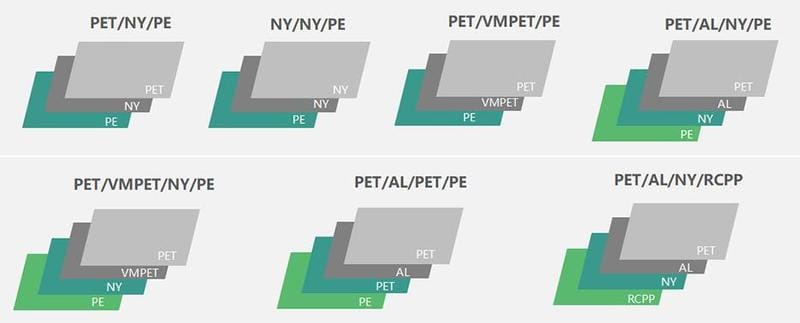
Film compatibility is defined by the actual film structure and operating conditions — not by the polymer name.
“PE compatible” doesn’t tell you the film thickness, width, laminate structure, sealant layer, coefficient of friction, roll diameter, core diameter, printing registration requirements, or the sealing temperature and pressure the machine can apply. All of those change how the machine actually runs.
LINTYCO’s VFFS options list makes this concrete: among the optional configurations for our vertical machines is a special device for running single-layer PE film. Read that carefully — a machine that seals laminated film structures well may need different sealing jaw geometry or heating behavior to run monolayer PE reliably, because PE has a narrower workable sealing window. Film structure isn’t a footnote to machine selection; it can change the machine configuration you need to order.
This matters even more with thinner gauge films and recyclable mono-material structures, where sealing windows get tighter. (See Mono-Material Film Sealing Problems and Solutions for the failure modes.)
If film performance matters to your project, test the actual film — not the material name. Send your real film spec (structure, thickness, width, COF if you have it) to the supplier before the machine is configured, not after it’s built.
Does installed power equal actual energy consumption?
No. Installed power and operating energy consumption are different specifications.
A machine’s listed power rating reflects the electrical capacity of its motors, heaters and components — not what it draws continuously in production. When comparing machines, clarify whether the number refers to installed power, motor power, heater power, peak demand, or typical operating consumption. If energy cost matters to your project, calculate operating cost under your actual duty cycle rather than reading it off the nameplate.
Does machine capacity equal real production output?
No. Nominal machine capacity is not effective production output.
Effective output is:
Machine speed × uptime − changeovers − product feeding stops − rejects − operator intervention
A machine advertised at 60 bags/min theoretically produces 3,600 bags/hour. Your real number will be lower, because of film roll changes, cleaning between lots, format changes, minor stops, rejects, maintenance and material handling. For serious purchases, compare effective throughput — which is why production planning should start from your required monthly output and work backward to machine capacity, never forward from a headline speed. The Throughput Planner exists precisely to run that calculation with shift patterns, uptime and changeover assumptions instead of brochure numbers.
What is the specification lifecycle — and why does the same number change at every stage?
Because product information passes through many hands between a supplier’s test bench and your production floor, and each stage either adds precision or loses it.
The full lifecycle:
Supplier Claim → Product Page → Technical Specification → Application Requirement → Machine Selection → Sample / Product Test → Technical Agreement → FAT → Production → Pre-shipment Inspection → Final Acceptance
| Stage | What it is | Why it exists |
|---|---|---|
| Supplier claim | The origin of the number — internal tests, a previous project, an engineering estimate | Even honest origins are tied to that application |
| Product page | The claim compressed into a few web fields | Compression strips the conditions (“60 bpm” loses product, bag, film, duration) |
| Technical specification | The machine defined by model, configuration and parameters | First document you can actually compare between suppliers |
| Application requirement | Your product, bag, film, output and accuracy needs | The fixed point the machine must match — not the other way round |
| Machine selection | Matching spec to requirement | Where “fits in the range” gets separated from “runs well” |
| Sample / product test | Your actual product and film run on the machine | Converts theoretical compatibility into evidence |
| Technical agreement | Agreed performance, conditions and configuration in writing | Freezes interpretations before money moves |
| FAT (Factory Acceptance Test) | The machine tested at the manufacturer against agreed criteria | Your last cheap chance to find problems — full protocol in our FAT testing guide |
| Production | Your specific machine built and configured | Serial-number-specific conformance |
| Pre-shipment inspection | The actual unit and accessories checked (in-house or third-party) | Verifies the unit you’re paying for, not the prototype |
| Final acceptance | The delivered machine performs the agreed function under agreed conditions at your site | The product-page number finally becomes a real-world result |
Each stage should make the information more precise. If you jump from product page straight to payment, you’ve skipped every stage that adds definition — and you own the ambiguity.
What is the Claim → Evidence → Acceptance framework?
Every critical specification should survive four questions before you sign anything.
| Step | Question | Example (speed) |
|---|---|---|
| 1. Supplier Claim | What does the supplier say? | “Up to 60 bags/min” |
| 2. Technical Definition | What exactly does the number mean? | Maximum demonstrated cycle rate? With which product, bag size, film, filling system? |
| 3. Test Evidence | How was it demonstrated? | Test report, video with your materials, sample run, FAT protocol |
| 4. Acceptance Criterion | What must your delivered machine achieve, measured how, under what conditions? | ≥50 bpm, 8-hour run, ≥48 good bags per 50 counted, measured at FAT with your product and film |
If a claim can’t pass from step 1 to step 4, it isn’t a specification yet — it’s marketing. This framework works identically for filling accuracy, seal quality, film compatibility and changeover time. It’s also supplier-neutral: apply it to every quotation you receive, including ours.
How should you verify a packaging machine before placing an order?
Use a staged verification process instead of trying to verify everything from the product page.
Step 1: Define your actual packaging requirement
Before comparing machines, document: product and its characteristics (density, particle size, flow, moisture), target filling weight, bag style, bag dimensions, film structure and thickness, required production volume, required speed, filling accuracy, available utilities (power, compressed air), and automation level. If these aren’t defined, comparing machine specifications is misleading — you’re matching unknowns against ranges.
Step 2: Normalize the supplier specifications
Ask every supplier to quote against the same units, product weight, bag dimensions, film conditions, speed definition, accuracy definition and test conditions. Otherwise you aren’t comparing machines; you’re comparing definitions.
Step 3: Ask whether each number is typical, rated, target or guaranteed
Add one question to your RFQ:
“Is this value typical, rated, maximum, target or guaranteed — and under what test conditions?”
This single question eliminates most specification ambiguity, because it forces the supplier to attach conditions to the number.
Step 4: Test your actual product and packaging material
A machine can look perfect on paper and behave differently with your product’s density, particle size, moisture, stickiness, flow characteristics — or your film’s structure and thickness. A sample test with your materials reveals what a datasheet cannot. Serious suppliers expect this request; a supplier who resists testing your actual product is telling you something.
Step 5: Put critical specifications into the technical agreement
Don’t leave important specifications living only on a marketplace page, in email, WhatsApp or WeChat threads, or in sales conversations. Move them into the formal technical documentation attached to the contract. Instead of “machine speed: 60 bags/min,” write:
Guaranteed output: ≥50 bags/min for [Product X] at [target weight], [bag style and size], [film structure], under the agreed operating conditions, verified by [test method] at FAT.
Now the specification has a definition, a test and a consequence.
Step 6: Define the acceptance test
A good acceptance criterion answers four questions: What is being measured? How is it measured? Under what conditions? What result counts as pass? Without all four, “the machine passed the test” is subjective.
What should be included in a packaging machine specification sheet?
A complete specification sheet turns a product page into a procurement document. Use this structure — the “How to Verify” column is what separates a sheet from a wish list:
| Category | Specification | What the Buyer Should Confirm | How to Verify |
|---|---|---|---|
| Machine | Model, version, configuration | Exact model code + serial-specific config | Technical agreement + BOM |
| Product | Product type and characteristics | Density, particle size, moisture, flow behavior | Product data sheet + sample test |
| Filling | Target weight, range, accuracy | Accuracy tied to product + weight + dosing technology | Weighing test with your product (sample size ≥ defined) |
| Bag | Style, width, length | Your exact bag style at your dimensions and speed | Bag/film sample run |
| Film | Structure, thickness, width | Structure (e.g., laminate vs mono-PE), COF, roll/core diameter | Film trial with actual rolls |
| Speed | Typical / maximum / guaranteed output | Which of the three types each number is | Application-specific run at FAT |
| Utilities | Power supply, installed power, compressed air | Voltage/phase/frequency; actual air pressure and consumption | Utility spec sheet + site check |
| Dimensions | Machine footprint, weight, clearances | Fits your floor, doorways, ceiling height | Dimensioned drawing |
| Configuration | Standard vs optional equipment | Which photo features are optional (e.g., nitrogen, servo sealing, PE-film device) | Itemized quotation + BOM |
| Controls | PLC, HMI, sensors, recipes | PLC/HMI brand, recipe storage, changeover method | Configuration list + HMI demo |
| Testing | Test product, film, conditions | Tests use your product and film, not substitutes | Written test plan before FAT |
| FAT | Acceptance criteria | Measured values, methods, pass thresholds | FAT protocol + report |
| Certification | Applicable models and documents | Certificates name the exact model; e.g., CE and ISO 9001 (request the certificate documents and check the model scope) | Document review against model |
| Warranty | Scope and duration | What’s covered, response time, parts vs labor | Written warranty terms |
| Spare parts | Recommended startup package | Wear parts list, prices, delivery time | Spare parts quotation |
| Delivery | Lead time, shipping configuration | Incoterms, packing, what ships loose vs installed | Order confirmation |
Generic procurement methodology — apply it to every supplier you evaluate.
How do you verify a VFFS machine specification?
Don’t compare VFFS machines by headline BPM. Compare the complete application specification.
Define your chain first:
Product → Filling system → Bag style → Bag size → Film → Target weight → Speed → Accuracy → Sealing → Utilities
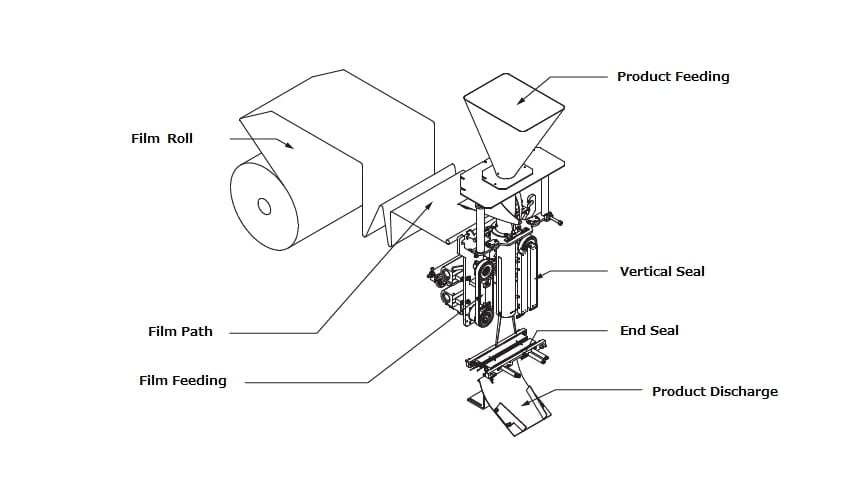
The filling system deserves special attention because it drives both speed and accuracy: snack foods typically pair the VFFS with a multihead weigher; powders usually need an auger filler (bulk-density-dependent); liquids shift the architecture entirely toward piston or pump filling with different sealing requirements. A product that technically fits a machine’s advertised filling range may still need a different dosing technology to hit your accuracy and throughput targets.
The right question is not “which VFFS machine has the highest speed?” but “which VFFS configuration can reliably produce my required package at my target output and quality level?”
Machine selection should start from the product and package, not from a machine model. If you want to shortlist configurations before talking to sales, the LINTYCO Machine Selector filters by product form, bag style and production scale — and it deliberately returns speed ranges, not promises. For the broader machine-type decision first, see VFFS vs Premade Pouch.
How do you verify HFFS and premade pouch machine specifications?
The same rules apply — plus a few format-specific traps.
For HFFS / flow wrapping, don’t compare only bags/min. Also compare package format, bag dimensions, film specification, product type, feeding system, sealing requirements, number of lanes, changeover and actual tested output.
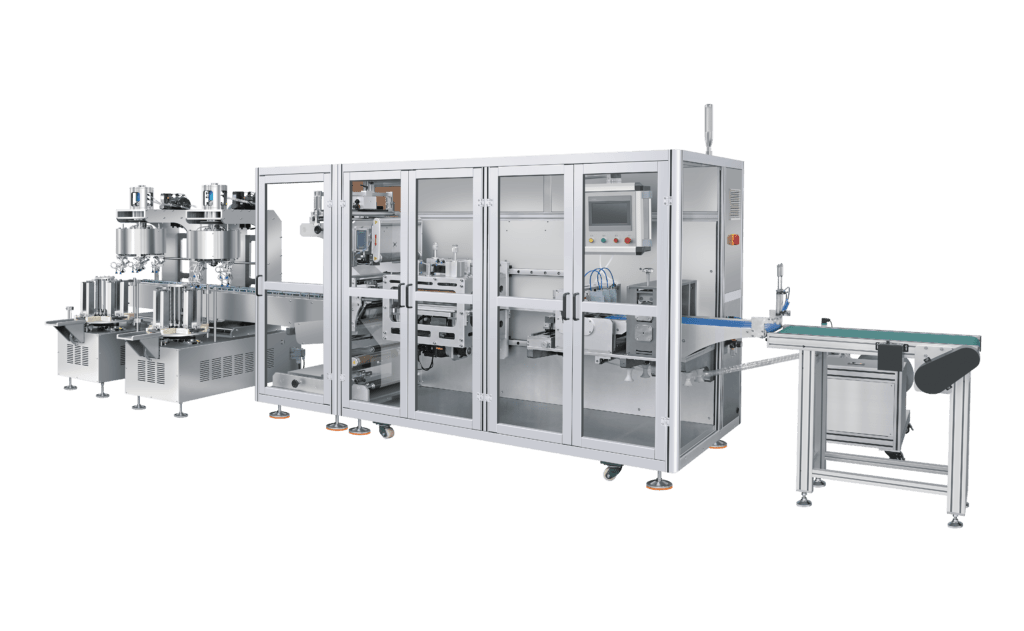
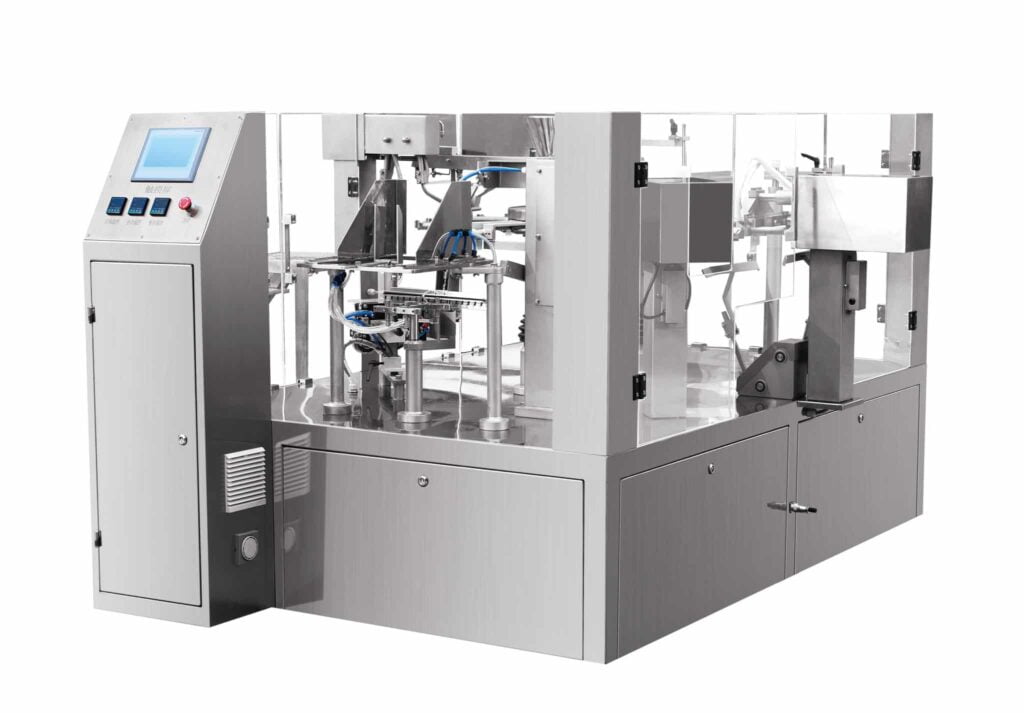
Real published data shows why. The BG800Z horizontal machine is listed at different speed bands for different bag styles on the same machine: a lower band for zipper pouches and a higher band for plain four-side-seal pillow pouches. Zipper forming and closing simply takes more cycle time than a plain seal. If a product page quotes only the higher number, you’d never know your zipper application sits in the lower band. (Again — reference values; confirm per application.)
For premade pouch systems, the equivalent traps are pouch-format limits (stand-up, doypack, spout, zipper, flat), how many stations touch the pouch, and what “up to X pouches/min” assumes about pouch quality and feeding. Both comparisons come down to the same discipline: the machine follows the packaging requirement, not the other way around.
How should you compare packaging machines beyond the headline price?
The cheapest machine isn’t necessarily the lowest-cost packaging solution.
A fair comparison includes machine investment, filling system, film consumption, labor, energy, maintenance, changeover, rejects, production capacity and expected service life. A machine with a lower purchase price but higher labor requirements or lower effective throughput can easily have a higher cost per bag. Move the comparison from price per machine to cost per package. (We’ve written about the full buying process in How to Buy a Packaging Machine from China and the classic traps in VFFS Machine Buying Mistakes.)
If you already know your product, output and packaging format, the packaging cost calculator estimates cost per package under your own operating assumptions — labor rate, shifts, film price, target uptime — rather than under a brochure’s.
How do you know whether a machine can meet your production target?
Start with required monthly output and work backward to machine capacity.
If your target is 2,000,000 bags/month, the inputs that matter are working days, shifts, hours per shift, sustainable bags/min (not maximum), expected uptime, changeover time and frequency, reject rate, and number of machines. Headline speed is only one input — and usually the least reliable one.
The real question is: how many good packages can the line realistically produce during available production time? The Throughput Planner runs exactly this calculation, and the production line configurator helps you check whether machine, filler and auxiliary equipment are balanced — a line is only as fast as its slowest station.
What should you ask a packaging machine supplier before buying?
If you keep one checklist from this article, use these twelve questions:
- What exact product was used to obtain the stated speed?
- What filling weight was tested?
- What bag size and bag style were tested?
- What film structure and thickness were used?
- Is the stated speed typical, maximum or guaranteed — and how was it measured?
- What filling accuracy was achieved under those same conditions, with what sample size?
- What filling/dosing system is included in the quoted configuration?
- Which features shown in the product photos are optional rather than standard?
- What are the actual electrical and compressed-air requirements?
- What test method and pass criteria will be used for FAT — agreed before the machine is built?
- Which specifications will be written into the technical agreement?
- What happens if the delivered machine does not meet the agreed acceptance criteria?
These questions are far more useful than “what is your best price?” For a supplier-evaluation angle, see 10 Practical Tips on Choosing a Packaging Machine Supplier and 5 Questions to Answer Before Requesting a Quotation.
How can LINTYCO help buyers reduce specification uncertainty?
By starting from your product and packaging requirement — not from a machine headline number.
The selection chain looks like this:
Product → Packaging format → Filling method → Machine configuration → Production requirement → Cost → Testing → RFQ
Instead of “which machine do you sell?”, the working question is “what are you packaging, in what format, at what output?” From there, machine type, filling technology and line configuration can be evaluated against the actual requirement.
LINTYCO’s free engineering tools support that sequence without a sales conversation: the Machine Selector (product form → bag style → scale), the Throughput Planner (required output → realistic capacity), the packaging cost calculator (cost per package), the production line configurator (line balance), plus the film roll calculator and bag styles gallery for material and format decisions.
Two things we hold ourselves to in this process: our published machine figures are presented as ranges and reference values to be confirmed against your application spec sheet — and project-specific capabilities, testing arrangements and service scope are always confirmed per project, in writing.
What is the most reliable way to evaluate an Alibaba packaging machine supplier?
Don’t rely on one signal. Build an evidence chain.
Product Page → Technical Specification → Written Confirmation → Product/Film Test → Technical Agreement → FAT → Pre-shipment Inspection → Final Acceptance
Each link answers a different question: the product page discovers suppliers; the technical specification defines the machine; the written confirmation freezes interpretations; the sample test proves compatibility; the agreement attaches consequences; FAT verifies performance before shipment; inspection checks the actual production unit; final acceptance closes the loop at your site.
That chain is much stronger than asking whether a supplier is “trusted” or “untrusted” — and it applies equally to a marketplace listing, a supplier website or a trade-show quotation.
What to remember before buying a packaging machine
- A product-page specification is a screening input, not a guarantee.
- “Maximum speed” is not guaranteed production output — and speed ranges exist for a reason.
- Filling accuracy must be tied to a product, target weight, dosing technology and test method.
- Bag-size ranges don’t transfer across bag styles; larger bags and heavier fills trade against speed.
- Film compatibility is a structure question (“which PE?”), not a polymer question.
- Typical, rated, maximum, target and guaranteed values are not interchangeable.
- A sample test proves one tested application — not every future production condition.
- Critical specifications belong in the technical agreement with defined acceptance criteria.
- FAT and pre-shipment inspection add evidence while problems are still cheap to fix.
- Compare effective throughput and cost per package — not machine price and headline BPM.
- The best machine is the one whose performance can be defined, tested and accepted for your application.
Frequently Asked Questions
Are Alibaba product specifications reliable?
They can be useful for initial supplier screening, but they shouldn’t automatically be treated as final acceptance specifications. A displayed number may be a typical, rated, maximum or best-case value measured under unstated conditions. Ask the supplier to confirm critical specifications in writing, with test conditions attached.
Do Alibaba product specifications equal supplier guarantees?
Not automatically. A product-page value is a claim; a guarantee is a contractual commitment with defined test conditions. For critical requirements, move the specification into the quotation, technical agreement or contract, and define how it will be tested.
Why can packaging machine speed differ from actual production output?
Because actual output depends on product behavior, bag size, filling weight, film, dosing system, machine configuration and operating conditions. A maximum cycle rate measured on one application doesn’t transfer to another. Ask for an application-specific test using your product, bag and film.
What is the difference between typical and guaranteed machine speed?
Typical speed describes representative performance; guaranteed speed is a contractual requirement under specified conditions, verified by an agreed test. They are not interchangeable. Ask which category every number in a quotation belongs to.
How do I verify VFFS machine specifications?
Define your product, filling weight, bag style and size, film, filling system and required output first — then verify with a sample test. Compare complete application specifications, not headline BPM. Use a specification sheet that records what each number means and how it will be tested at FAT.
How do I verify filling accuracy?
Specify target weight, product, filling technology (multihead, auger, piston, volumetric), test conditions, sample size and acceptable tolerance. For powders, include bulk-density behavior — volumetric dosing accuracy tracks density directly. Request test results using your actual product whenever possible.
How do I verify packaging film compatibility?
Test the actual film structure, thickness and format rather than accepting “PE compatible.” Film structure can change the machine configuration needed — some machines need specific sealing setups for monolayer PE. Send your real film specification to the supplier before the machine is configured.
Should I ask for a factory acceptance test?
For high-value or application-critical equipment, yes — FAT is your last inexpensive checkpoint. Define test conditions, materials and pass criteria before the machine is built. Don’t wait until the machine is finished to decide what “pass” means.
Should packaging machine specifications be in the contract?
Yes. Machine configuration, performance requirements, test conditions and acceptance criteria belong in the technical agreement attached to the contract. Don’t leave critical requirements only in a product-page screenshot or a chat message.
When should I use third-party inspection?
When purchase value, customization level, compliance requirements or the cost of failure justify independent verification. Inspection is most valuable for checking the actual production unit against the agreed specification before shipment. Define the inspection scope against the technical agreement, not against the product page.
How can I compare two packaging machine suppliers fairly?
Normalize the specifications first: same product, weight, bag size, film, output definition, utilities and configuration scope. Then compare effective capacity, total operating cost and acceptance criteria. A fair comparison ends at cost per package, not price per machine.
How do I calculate effective packaging machine throughput?
Start from required monthly output and work backward: shifts × hours × sustainable speed × uptime, minus changeovers and rejects. Headline speed is only one input — and the least reliable one. Use a throughput calculation with your real shift pattern and uptime assumptions, not the brochure number.
How do I create a packaging machine RFQ?
Specify your product, target weight, bag style and dimensions, film structure, required output, accuracy target, utilities and automation level — then ask every supplier the same twelve verification questions. A complete RFQ lets suppliers quote comparable configurations. Include the Claim → Evidence → Acceptance framework for every critical number.
How can LINTYCO help me choose a packaging machine?
LINTYCO approaches selection from the product and packaging requirement, using free planning tools — machine selector, throughput planner, cost calculator and line configurator — before any sales conversation. Published machine figures are ranges to be confirmed against your application. Start by defining your product, package format and production target.
What should be included in a packaging machine specification sheet?
Machine model and configuration, product, filling target and accuracy, bag style and size, film, speed (typed as typical/maximum/guaranteed), utilities, dimensions, configuration options, controls, test plan, FAT criteria, certification, warranty, spare parts and delivery terms. Each row should state how it will be verified. Use the 16-category sheet in this article as your template.
Final Thought
A supplier saying “60 bags/min” isn’t necessarily giving you bad information. But it isn’t enough information either.
The professional response isn’t “I don’t believe you.” It’s:
“Under what conditions?”
Then:
“Can we test it with my product and film?”
And finally:
“Can we write the agreed result into the acceptance specification?”
That’s the difference between comparing products online and engineering a procurement decision.
Don’t buy the biggest number on the product page. Buy a clearly defined performance you can test, document and accept.



 English
  Spanish
  Russian
  Korean
  French
  German
  Italian
  Arabic
  Thai
Thai  Chinese
  Vietnamese
  Japanese
  Portuguese
  Dutch
Dutch  Malay
Malay