
Most packaging professionals ask the wrong question when a 20-micron film fails on a VFFS machine.
They ask: “What’s wrong with the film?”
In reality, thin films rarely fail alone. They expose weaknesses across the entire packaging system — from machine design and sealing control to operator training, material selection, and economic decision-making.
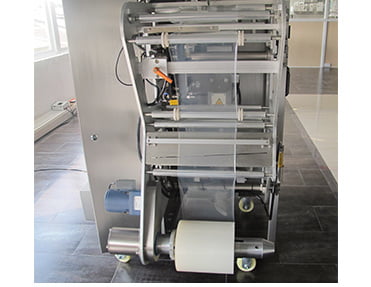
Here’s the uncomfortable truth: thin films don’t create problems. They reveal them.
When you switch from an 80-micron PET/PE laminate to a 20-micron mono-PE film, the machine doesn’t suddenly break. The operator doesn’t suddenly become careless. The product doesn’t change.
What changes is the tolerance for error — and most packaging systems weren’t built for it.
Why Is the Industry Moving Toward Thin Films — And Is Your System Ready?
Not sure which vffs packaging machine fits your needs? Get a personalized recommendation in 60 seconds.
Find the Right VFFS Machine →The industry isn’t shifting to thinner films because someone had a visionary moment at a trade show. It’s happening because the pressure is real and it’s accelerating.
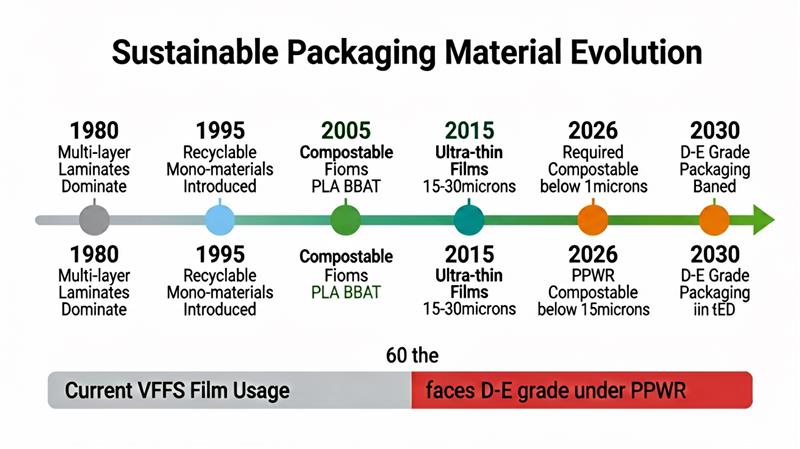
The EU’s PPWR (Packaging and Packaging Waste Regulation) grades packaging from A to E for recyclability. Only A–C survive past 2030. Multi-layer laminates — the dominant film structure on VFFS machines worldwide — score D or E. That’s not a prediction. That’s the grading methodology: layers that can’t be separated economically are non-recyclable, full stop.
Brand owners face mounting demands from retailers, regulators, and consumers to use less material while maintaining performance. The math is simple: thinner film = less material = better recyclability score = lower cost per package (when it runs correctly).
But there’s a gap between the direction the industry is heading and the readiness of the systems meant to get there.

According to Interpack 2026 data, roughly 60% of current VFFS film usage faces D or E grades under PPWR criteria. Companies that want to keep selling in the European market need mono-material PE or PP films. Those films typically run at 30–50 microns — sometimes thinner.
And that’s where most packaging systems start to crack.
Not because the film is defective. Because the system around it isn’t ready.
Is Thin Film Failure Really a Material Problem — Or Something Else Entirely?
Here’s what happens when a thin film fails on a VFFS machine:
Someone blames the film supplier. The supplier sends a test report showing the film meets all specifications. The packaging engineer checks the machine settings. The operator shrugs. Production loses half a roll before reverting to the thicker film everyone feels comfortable with.
Then the conclusion gets written in a meeting room: Thin films don’t work on our line.
That conclusion is wrong. Not partially wrong. Fundamentally wrong.
Thin film failure is not a material problem. It’s a packaging system problem.
Think about it this way: when a thin film fails, five things are always involved at once — the film itself, the machine it runs on, the product being packaged, the process settings, and the economics driving the decision. Change any one of them without adjusting the others, and failure is inevitable. No amount of “better film” will fix a broken system.
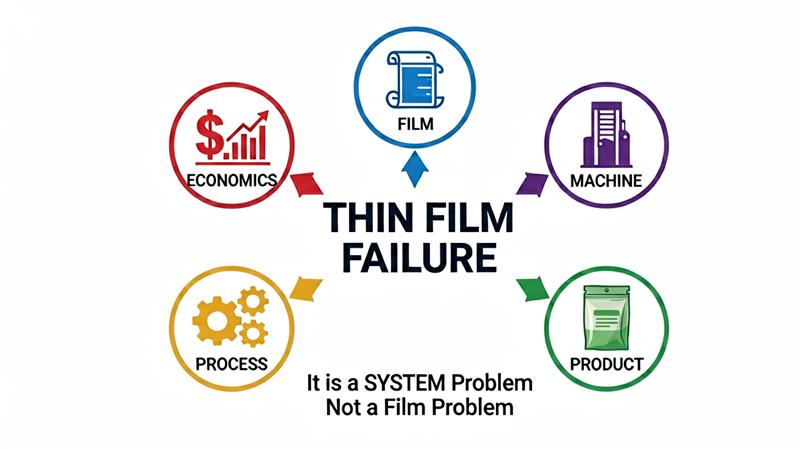
Five variables. All of them interact. If even one is out of alignment, thin film fails — regardless of how perfect the film specifications are.
Let me break down why, through five different expert perspectives. None of them say “buy better film.”
What Does a Packaging Engineer See When a Thin Film Starts Failing?
A 20-micron film is roughly the thickness of a standard grocery bag. The same bag you can tear with your thumb. Now imagine that bag moving at 40 bags per minute through a forming collar, under tension controlled by a dancer roller that hasn’t been cleaned in three weeks, past seal bars whose Teflon tape was last replaced during the last quarter’s production run.
Thin films don’t need perfection. They need significantly more of it than thicker films do.

Here’s what the packaging engineer sees:
Film tracking. A 60-micron PET/PE film can drift slightly on the forming collar and nobody notices. A 20-micron mono-PE film tracking 2 millimeters off-center will wrinkle, tear, or create a misaligned back seal. The film itself isn’t defective — the forming collar alignment is 2 millimeters off. You wouldn’t notice that difference with a thicker film. You notice it immediately with a thin one.
Tension control. Film tension doesn’t scale linearly with thickness. Going from 80 microns to 20 microns is a 4x reduction in material, but the tension tolerance is closer to a 10x reduction. The dancer roller system needs to respond faster, with finer resolution. If your machine uses a fixed brake system rather than a servo-driven tension controller, thin films will either stretch thin and break or feed too loosely and wrinkle.
Jaw pressure. The horizontal sealing jaws apply pressure to bond the seal layers together. On a thicker film, slight pressure variation across the jaw length is invisible. On a 20-micron film, uneven pressure creates a seal that’s strong at one end and weak at the other — the exact failure mode that gets blamed on “bad film.”
Sealing consistency. This is the big one. A PET/PE laminate at 80 microns seals reliably at 150–180°C. A mono-PE film at 20 microns seals reliably at 110–140°C. That’s a 40-degree window instead of a 30-degree window, yes — but the real issue is that the thinner film reaches seal initiation temperature faster. If your heating elements have any degradation (and they all do, over time), the actual jaw temperature fluctuates beyond the acceptable range. The film doesn’t fail because it’s thin. It fails because the temperature control system can no longer hold ±2°C stability.
The film isn’t the weak link. It’s the measuring stick.
What Does a Material Scientist See When You Swap Laminates for Mono-Material Films?
Let’s get one thing straight: a 20-micron mono-PE film is not the same thing as an 80-micron PET/PE film, period. Different polymers. Different seal structures. Different barrier mechanisms. Different everything except the bag shape they make.
But the industry often treats them as interchangeable — just swap the roll and go. That’s like swapping regular gasoline for premium in a car tuned for regular and expecting identical performance. It might run. It might run fine for a while. Then something breaks.
Here’s what the material scientist knows:
Seal initiation temperature. Mono-PE films initiate sealing at lower temperatures than PET/PE laminates. Lower doesn’t mean worse — it means different. The sealing jaw has to hit that lower window precisely. Too hot and the film melts through. Too cold and the seal won’t bond. With a thicker film, the margin for error absorbs the mistake. With a thin film, there is no margin.
Seal window. The seal window is the temperature range where a film seals reliably. Mono-PE films have a narrower seal window than many laminates. This isn’t a quality issue — it’s physics. Single-polymer structures don’t have the multi-layer buffer that laminates provide. The VFFS machine needs a sealing system capable of operating within a tighter temperature band. Ultrasonic sealing — which generates heat within the film rather than applying external heat — handles this significantly better than conventional heat sealers.
Coefficient of friction (COF). Thin films slide differently than thick films. A mono-PE film at 20 microns has a different COF profile than an 80-micron PET/PE. That affects how the film tracks through the tension system, how it wraps around the forming collar, and how the sealing jaws grip it during the seal cycle. If your machine was calibrated for a higher-CF film and you swap to a lower-COF thin film without adjusting, the film will slip, drift, or bunch up.
Layer structure. A PET/PE laminate has three jobs: PET provides strength and printability, PE provides sealability, and anything in between (AL, EVOH, SiOx) provides barrier. A mono-PE film does all three with one polymer. The trick is that the barrier properties come from coatings — EVOH at less than 5% of total weight, or nanometer-thick SiOx/AlOx deposits. These coatings are incredibly thin. They’re also incredibly sensitive to mechanical stress during forming. If the forming collar surface isn’t polished to Ra ≤ 0.4 μm, the coating micro-cracks during forming, and the barrier fails. The film didn’t fail. The coating failed. And the coating failure is caused by a mechanical condition most operators don’t even measure.
Mono-material design. The reason mono-PE and mono-PP films achieve PPWR Grade A recyclability is that they’re made of a single polymer type. That’s also their Achilles’ heel: they lack the structural redundancy of laminates. When a multi-layer film has a weak seal, the outer layers still hold. When a mono-PE film has a weak seal, there’s nothing else to fall back on.
You can’t run a mono-material film on a machine designed for laminates and expect it to behave the same. It was designed to behave differently.
Are Most Thin Film Failures Actually Organizational Failures in Disguise?
This is the perspective most technical articles skip because it’s uncomfortable.
Many thin film failures aren’t caused by film, machine, or process. They’re caused by people and culture.
Here’s the pattern, and I’ve seen it repeat across dozens of facilities:
A brand owner decides they need to reduce material usage. The sustainability team calculates that going from 80 microns to 30 microns achieves their reduction target. They instruct procurement to source thinner film. Procurement finds a supplier. The film arrives. It gets loaded onto the VFFS line. Production starts.
Within the first shift, reject rates spike from 2% to 15%. The operator calls maintenance. Maintenance adjusts temperature. Rejects go to 20%. The production manager calls a halt. The film gets quarantined. The brand owner concludes: Thin films don’t work.
Nobody in that chain was wrong. Nobody was careless. They just followed the most common — and most incorrect — sequence: reduce material, swap the film, watch rejects climb, quarantine the batch, and conclude that thin films don’t work.
The correct sequence is far less glamorous but far more effective: evaluate your system first, validate the film against it, run a pilot at reduced speed, optimize parameters based on real data, then scale.
The difference between those two sequences is one word: evaluate.
Before you buy thinner film, evaluate whether your packaging system can handle it. Before you swap the roll, check the machine. Before you blame the film, check the operator’s training level. Before you declare failure, check whether anyone on the floor knows what a seal window is.
The skeptic’s point is blunt but fair: thin film implementation fails most often because organizations treat it as a material swap instead of a system upgrade.
You wouldn’t put racing fuel in a minivan and complain about the ride quality.
Will Thin Films Actually Save Money — Or Just Move the Costs Around?
Here’s the financial reality that nobody puts on a spec sheet:
Roll stock film for VFFS packaging costs 40–60% less than equivalent premade pouches. That’s why VFFS exists. But thin films don’t automatically reduce cost per package — they can, if the machine runs them efficiently.
Let’s do the math on a real scenario.
A mid-volume operation produces 500,000 pouches per month. Currently running 80-micron PET/PE at $3,200/month in film costs. They switch to 30-micron mono-PE at $2,400/month — a $800 monthly savings on paper.
But thin film causes 8% more rejects instead of 2%. That adds $260 in wasted material. Downtime for troubleshooting adds $400 in lost production. The net savings? $140 per month.
On paper, the thin film project “failed.” Financially, it barely broke even. The film itself wasn’t the problem — the reject rate and downtime were. But those are symptoms of system unreadiness, not film defects.
Here’s what the packaging economist tracks:
Material savings. Going from 80 microns to 30 microns is a 62.5% reduction in material weight per pouch. On paper, that’s huge. In practice, the cost per kilogram of mono-PE is 10–20% higher than PET/PE laminate. So the actual cost savings per package is more like 35–45%, not 62.5%. Still significant, but you need to model it correctly.
Downtime cost. Every thin film failure event costs more than just wasted film. It costs production time. At 40 BPM, losing 30 minutes of production equals roughly 7,200 bags not filled. For a snack food at $0.08 per bag in revenue, that’s $576 in lost output per incident. If thin film causes two incidents per week, that’s $4,608 in lost production annually — far exceeding the $9,600 in annual material savings.
OEE impact. Overall Equipment Effectiveness drops when thin films run poorly. Availability decreases (more downtime). Performance decreases (slower speeds to compensate for film sensitivity). Quality decreases (higher reject rate). All three dimensions of OEE suffer simultaneously, and the compound effect is worse than the sum of individual losses.
CAPEX for upgrades. Making thin films work reliably often requires investment: servo-driven tension controllers ($1,500–3,000), ultrasonic sealing units ($8,000–15,000), polished forming collars ($1,000–3,000). These aren’t optional accessories anymore — they’re prerequisites for thin film success. The ROI calculation must include them.
The real question isn’t “can this film run?” It’s “can this film run profitably on our system?”
Thin films succeed only when the ROI succeeds. And ROI depends on system readiness, not film specs.
Did Every Major Packaging Innovation Face the Same Resistance — Including Thin Films?
This isn’t the first time the packaging industry has been told something can’t be done.
When servo systems replaced mechanical drives on VFFS machines, operators complained about complexity. When recyclable mono-material films first appeared, material scientists said they couldn’t deliver adequate barrier properties. When MAP (Modified Atmosphere Packaging) became standard, everyone said the nitrogen flushing would compromise seal integrity. Each time, the resistance was real. Each time, the innovation won — because the system adapted, not because the technology magically improved.
Thin films follow the same pattern.
The resistance isn’t about thin films being inherently unworkable. It’s about the same thing that resisted every packaging innovation before them: change requires system adaptation, and system adaptation costs time, money, and organizational effort.
The historian’s point is simple: the question isn’t whether thin films will become standard. They already are, driven by PPWR and material reduction targets. The question is whether your system will be ready when the deadline arrives.
August 2026: tea bags, coffee pouches, and very lightweight bags below 15 microns must be compostable. August 2030: D and E grade packaging is banned from the EU market.
The clock is ticking. The films are ready. The machines mostly aren’t.
Why Do Thin Films Expose Weaknesses That Thicker Films Hide?
Here’s the framework that ties all five perspectives together: product, film selection, machine capability, process robustness, operator skill, and economic viability — each link affecting every other. Weakness at any point cascades downstream.
The most common mistake I see: customers buy thinner film first. They treat it as a simple material substitution. Then they wonder why production falls apart.
The correct order: evaluate system readiness first.
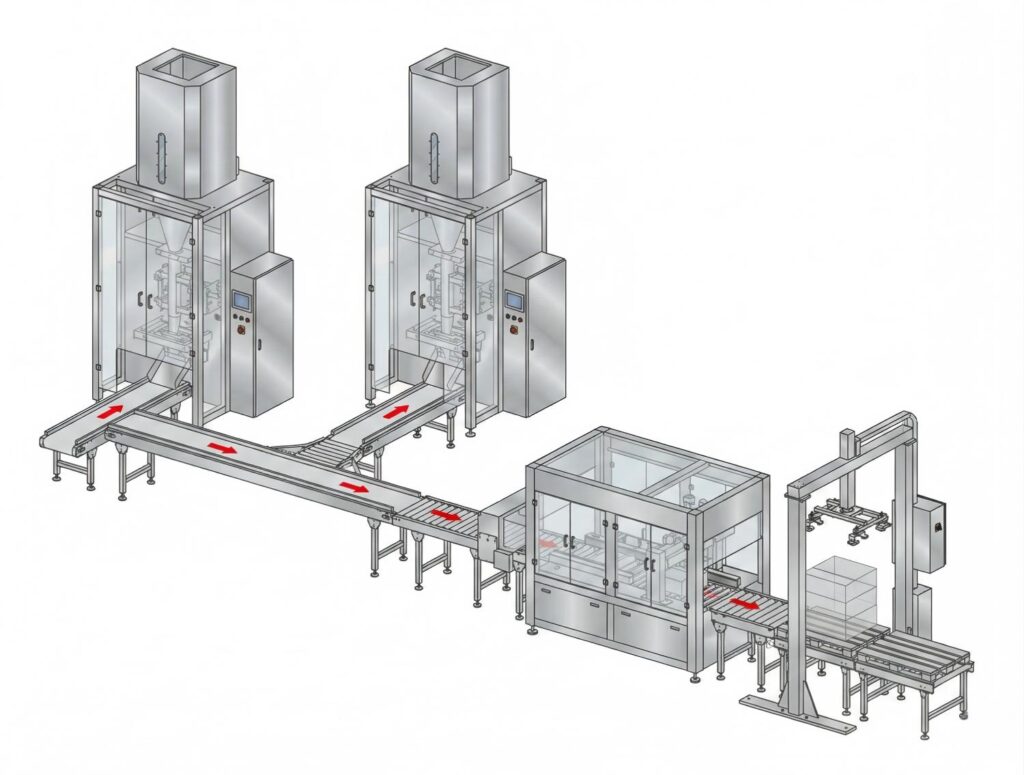
Before you touch the film spec, evaluate five readiness dimensions:
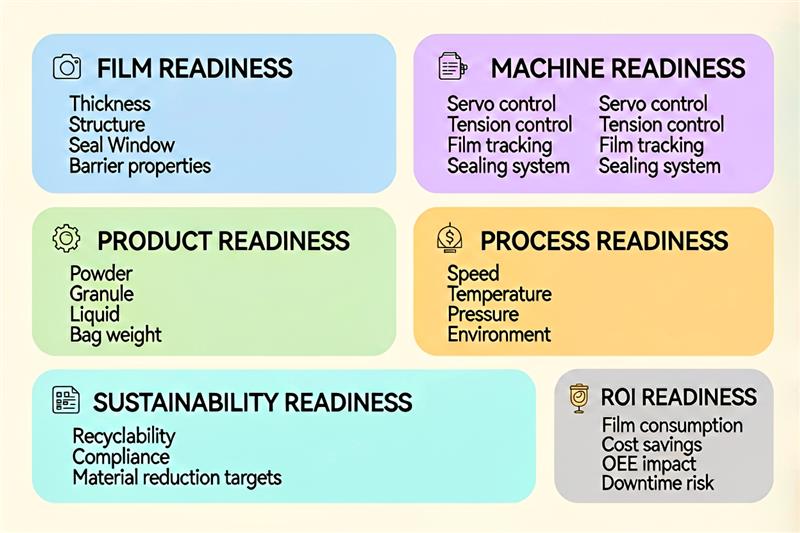
Film Readiness
| Check | What to Verify |
|---|---|
| Thickness | Is the target thickness within your machine’s operational range? |
| Structure | Is it mono-material, laminate, or compostable? Each requires different sealing. |
| Seal window | Does the film manufacturer provide the seal temperature range? Is it narrower than your current film? |
| Barrier properties | Does the film rely on thin coatings (EVOH, SiOx)? These are mechanically sensitive. |
Machine Readiness
| Check | What to Verify |
|---|---|
| Servo control | Does your machine use servo-driven film transport, or mechanical pull-down? |
| Tension control | Is it a dancer roller system with feedback, or a fixed brake? |
| Film tracking | Can the forming collar handle the film width and track within ±1mm? |
| Sealing system | Are the seal bars capable of ±2°C stability? Do you have ultrasonic option? |
| Heating elements | When were they last replaced? Degraded elements cause temperature drift. |
Product Readiness
| Check | What to Verify |
|---|---|
| Product type | Powder, granule, or liquid? Each affects seal contamination risk. |
| Bag weight | Heavier bags create more stress on the bottom seal during discharge. |
| Filling speed | Faster filling = less time for stable film transport between cycles. |
Process Readiness
| Check | What to Verify |
|---|---|
| Operating speed | Can you run thin films at your target speed, or do you need to reduce? |
| Temperature profile | Is the seal temperature within the film’s specified range? |
| Pressure settings | Are jaw pressures calibrated for thin-film sensitivity? |
| Environment | Humidity above 70% affects hygroscopic powders. Below 30% creates static issues. |
Sustainability Readiness
| Check | What to Verify |
|---|---|
| Recyclability target | Does the film achieve the recyclability grade your market requires? |
| Regulatory compliance | Will the film structure be legal in your target markets by 2026/2030? |
| Material reduction | Does the thinner film actually reduce total material usage, or just weight? |
ROI Readiness
| Check | What to Verify |
|---|---|
| Annual film consumption | Calculate current cost vs. projected thin film cost. |
| Cost savings | Include material savings, OEE impact, reject rate changes, and upgrade CAPEX. |
| Downtime risk | Model worst-case: how much revenue loss per hour of thin-film-related downtime? |
If you can’t answer these questions confidently, thin film will fail — not because the film is bad, but because the system isn’t evaluated.
Why Do Brand Owners Get Thin Film Projects Wrong — And How to Avoid It?
Brand owners are under genuine pressure. Their customers demand sustainable packaging. Their regulators demand recyclability. Their investors demand cost reduction. The logical response: go thinner.
But the execution often follows this pattern:
Step 1: Reduce material. The directive comes from above. Find a thinner film. Hit the reduction target.
Step 2: Switch to thinner film. Procurement finds a supplier. The film meets specs on paper. Order is placed.
Step 3: Production instability. The film loads. The rejects start. The machine runs slower. The operator calls for help. Nobody has thin film experience.
Step 4: Thin film project failure. The film gets pulled off the line. The thicker film goes back on. The project is shelved.
Step 5: Conclusion: thin films don’t work. The narrative gets cemented: “We tried. It didn’t work.”
The flaw in this sequence is that it treats thin film as a procurement decision rather than an engineering project. It’s not. It’s a system transformation.
The right path looks different:
Step 1: Evaluate system capability. Before specifying film, audit the machine, process, and operator readiness.
Step 2: Validate film compatibility. Run pilot batches with the thin film at reduced speed. Document every failure mode.
Step 3: Pilot production. Full-speed pilot on a dedicated line. Collect OEE data. Compare against baseline.
Step 4: Optimize parameters. Adjust temperature, tension, speed, and jaw pressure based on pilot data. Train operators on the differences.
Step 5: Scale production. Roll out to all lines. Monitor KPIs. Iterate.
The difference between these two paths is the word evaluate at step one. Everything else follows from that decision.
The Real Question You Should Be Asking About Thin Films on VFFS
Stop asking: Can 20-micron film run on a VFFS machine?
Start asking: Is my packaging system ready for thin films?
The first question has a simple yes/no answer that depends on lab conditions. The second question has a nuanced answer that depends on your actual production environment — and that’s the answer that matters.
A film that runs perfectly on a manufacturer’s demo machine may fail on your production line. Not because the film is different. Because your forming collar is worn, your tension system is mechanical instead of servo-driven, your operators haven’t been trained on mono-material films, and your seal bars haven’t been calibrated in six months.
The film is just holding up a mirror.
Frequently Asked Questions
Can VFFS machines run 15-micron films?
Modern VFFS machines with servo-driven film transport and ultrasonic sealing can reliably process films down to 15 microns. Older machines with mechanical pull-down systems typically have a practical minimum of 30–40 microns. Below 20 microns, you need precision tension control, polished forming surfaces, and operators trained specifically on ultra-thin film behavior.
Are thinner films always less reliable?
No. Thinner films are more sensitive to system conditions, but that doesn’t make them inherently unreliable. A 20-micron mono-PE film running on a properly calibrated VFFS with servo tension control and correct sealing parameters is just as reliable as an 80-micron laminate. The difference is that the thinner film has less tolerance for deviation from optimal conditions. It’s the difference between a sports car and a sedan: both are reliable when driven correctly. Neither is reliable when driven incorrectly.
Why do mono-material films fail on packaging machines?
Mono-material films fail most often because they’re run on machines configured for multi-layer laminates. The sealing temperature range is different. The tension sensitivity is different. The forming collar surface finish requirements are different. When you swap a mono-PE film onto a machine calibrated for PET/PE without adjusting the system, failure is inevitable — not because the film is flawed, but because the system settings are wrong for the new material.
How do I reduce film thickness without increasing rejects?
Evaluate system readiness before changing film. Specifically: calibrate seal bar temperature within ±2°C, upgrade to servo-driven tension control if using mechanical systems, inspect and polish forming collars, replace worn Teflon tape on seal bars, and train operators on the specific behavior of thinner films. Then run a pilot at reduced speed, collect data, optimize, and scale. Don’t skip the pilot.
What machine capabilities are required for thin films?
At minimum: servo-driven film transport, precision tension control (±0.5 N accuracy), seal bar temperature stability within ±2°C, polished forming collar surface (Ra ≤ 0.4 μm), and regularly maintained Teflon coating on seal bars. For films below 25 microns, ultrasonic sealing is strongly recommended over conventional heat sealing.
How can I evaluate whether my packaging line is ready for thin films?
Use the six readiness dimensions above: film, machine, product, process, sustainability, and ROI. If you can’t confidently assess at least four of the six, start with a compatibility evaluation before making any film changes. Lintyco offers thin film readiness assessments for existing VFFS installations.
Find the Right VFFS Machine
Get a personalized recommendation tailored to your product and production target.
- ✓ Machine type for your vffs product
- ✓ Packaging format (pouch, sachet, bag)
- ✓ Production capacity match
- ✓ Optional configurations + auxiliary equipment
Before Reducing Film Thickness
Thin film failure is rarely a film problem. It’s a packaging system problem.
The industry is moving toward thinner, recyclable films whether every packaging line is ready for the transition or not. The brands and operations that succeed are the ones that evaluate their system capability before they swap the film roll — not after the rejects start climbing.
The right film on the wrong machine will always fail.
At Lintyco, we help customers assess machine capability, film compatibility, and process requirements before thin film implementation. Because the goal isn’t just to run thinner film — it’s to run it profitably, reliably, and sustainably.
📧 Email: [email protected]
🌐 Evaluate Your Packaging System for Thin Film Readiness →



 English
  Spanish
  Russian
  Korean
  French
  German
  Italian
  Arabic
  Thai
Thai  Chinese
  Vietnamese
  Japanese
  Portuguese
  Dutch
Dutch  Malay
Malay