
A pharmaceutical buyer I spoke with last month spent $65,000 on a thermoforming line. Six months later, he discovered his API requires a WVTR below 0.02 g/m²/day. The machine he bought? PVC thermoforming. WVTR: 2.5. He’s now running that line for stable tablets only, and shopping for an ALU-ALU system.
That’s a $65,000 lesson I’d rather you not repeat.
So here’s the thing about blister packaging machines — most selection guides will dump specs and tables on you and call it a day. But the real decision comes down to one question nobody asks out loud: “Is my product going to degrade before my customer opens it?”
Everything else — speed, film type, budget — flows from that answer.
It Starts With Your Product, Not The Machine
Explore packaging machine options for your industry. Get a recommendation based on your product type.
Find the Right Packaging Machine →Most buyers start with “how fast is it?” or “how much does it cost?” I get it. But the product sitting in front of you doesn’t care about your budget spreadsheet.
What it cares about: moisture, light, oxygen.
PVC thermoforming gives you a clear, beautiful blister. Your product sits there, perfectly visible, looking great on a pharmacy shelf. But here’s what’s happening behind the scenes: water vapor is slowly seeping through that PVC — about 2.5 to 3.5 grams per square meter per day. For a paracetamol tablet? No problem. For a moisture-sensitive statin? Your shelf life just got cut in half.
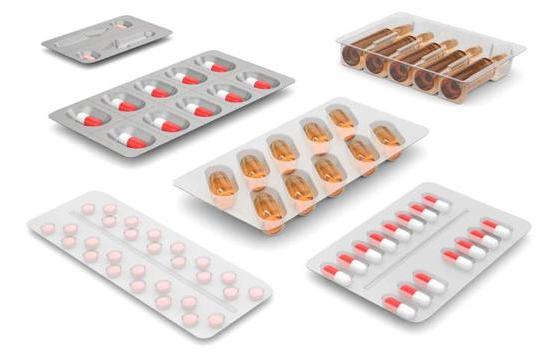
Cold-formed ALU-ALU, meanwhile, is ugly — opaque, crinkly, takes up more space. But it blocks virtually everything. WVTR: under 0.01. If your molecule falls apart at the slightest hint of humidity, this isn’t an option. It’s the only option.
The rule of thumb nobody wrote down: If your API can tolerate humidity swings in a bathroom cabinet for 18 months, PVC is fine. If not, start your search with ALU-ALU.
A colleague in generics put it bluntly:
“We test every new molecule against PVC first because it’s $2–5/kg instead of $8–15. But about 30% of the time, stability data sends us straight to ALU-ALU. That’s not a failure. That’s just doing the work.”
PPWR Is Not a Footnote Anymore
If you’re selling into the EU, there’s a regulation called PPWR (2025/40) quietly reshaping which blister films you can use.
By 2030, all packaging needs ≥70% recyclability grade — that’s A, B, or C on the EU’s scale. By 2038, it’s Grade A or nothing.
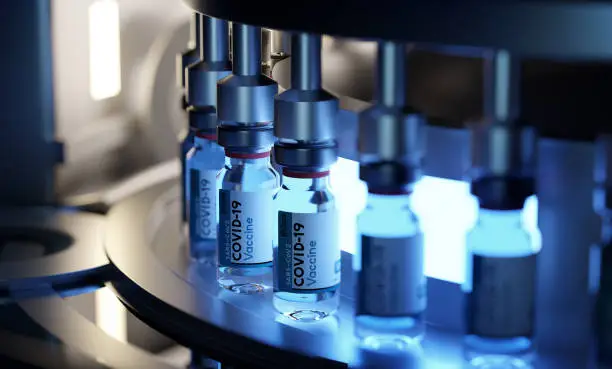
Here’s the uncomfortable reality: multi-layer laminates — including most ALU-ALU and PVC/PVDC combinations — score D or E. They don’t separate cleanly in recycling streams. Nobody’s figured out how to recycle them economically.
What does score well? Mono-material PVC and PET-based blisters. Grade A–B territory.
I’m not going to tell you ALU-ALU is dead — it’s not. If your product needs it, you use it. But if you’re buying a new line today that’s supposed to last 10+ years, ask the manufacturer one question: “Can this run mono-material PVC or PET without modification?”
If they hesitate, keep shopping.
What Nobody Tells You About Machine Speed
Every spec sheet lists blister-per-minute rates. And everybody fixates on the biggest number.
But here’s a cleaner way to think about it: your machine speed should match your actual daily output, not your ambition.
I’ve seen startups buy 300 blister/min rotary systems because “we’ll grow into it.” Two years later, they’re running it at 40% capacity, burning electricity, and still doing format changeovers that take 90 minutes because the machine was designed for 24/7 pharma runs, not small-batch flexibility.
| Your Daily Output | Don’t Buy | Buy Instead |
|---|---|---|
| Under 50K units | 200+ blisters/min | Semi-auto flat-plate (20–80/min) |
| 50K–200K units | Rotary | Automatic flat-plate (80–120/min) |
| 200K+ units consistently | Flat-plate | Rotary (200–400/min) |
An Indian generics manufacturer told me their best decision wasn’t upgrading speed — it was running two 120/min flat-plate machines in parallel instead of one 300/min rotary.
“When one goes down for maintenance, we’ve still got 50% output. With one big machine, we’d be at zero.”
That’s the kind of thinking spec sheets don’t teach you.
The Film Decision, Made Simple
Let me collapse the material selection into something you can actually act on:
Product stable, budget tight, selling wherever? → Mono-material PVC. $2–5/kg. PPWR Grade A–B. Works.
Product slightly moisture-sensitive, still want transparency? → PVDC-coated PVC. Cheaper than ALU-ALU, barrier decent (WVTR 0.4–0.8). But PPWR will bite you after 2030.
Product highly sensitive, moisture is the enemy? → ALU-ALU cold forming. No debate. Opaque, expensive, but zero compromise on protection.
Selling EU, want PPWR-proof, product isn’t ultra-sensitive? → PET-based blister. Recyclable, clear, WVTR around 1.5–2.0. Growing fast.
Honest note: I wish I could tell you there’s already a fully recyclable ALU-ALU alternative with the same barrier performance. There isn’t. Materials science is working on it. For now, if you need ALU-ALU for drug stability, use ALU-ALU and keep monitoring PPWR developments.
The Maintenance Stuff That Actually Matters
Every manual lists daily/weekly/monthly tasks. Here’s what bites people in practice:
Sealing plates wear unevenly. You won’t notice until every third blister leaks. Replace them every 6–12 months on continuous lines. Keep a spare set — they’re $200–800 and a two-hour swap, versus a batch rejection that costs thousands.
Compressed air fluctuations are the hidden killer. A 0.5 bar drop during sealing and suddenly your WVTR specs mean nothing. Drain your air system daily. Takes five minutes. Skipping it costs batches.
Format changeovers get rushed because production is waiting. Label your molds. Photograph the setup. Train two people — not one — on changeover. When your only expert calls in sick, you don’t want a $40K machine sitting idle.
One pharma line manager told me: “Our daily forming mold cleaning is the most boring 15 minutes of my shift. But I’ve never had a cavity defect in three years. The guy on the night shift who skips it? Gets at least one per week.”
Common Problems & Quick Fixes
Cavity Wall Thinning
Uneven film stretching causes thin cavity walls that tear during transport. Fix: Keep forming depth-to-width ratio below 1:1.5. Bump heating temperature by 5–10°C for more uniform stretch. Check compressed air — maintain 4–6 bar.
Seal Leaks and Delamination
Lidding foil separates from base web, letting moisture in. Fix: Match sealing temperature to your lidding material’s heat-seal coating range (typically 150–180°C). A 0.5 bar pressure drop is enough to cause edge leaks. Replace sealing plates when surfaces show wear patterns.
Product Damage During Forming
Fragile tablets crack during forming or sealing. Fix: Soft-touch feeders (silicone-coated), not metal contact. Give your product 0.5–1.0 mm clearance inside the cavity. For cold forming, slow punch speed by 15–20%.
Print Misalignment on Lidding Foil
Batch numbers drift across the web. Fix: Check foil tension on the unwind reel — uneven tension causes 1–3 mm drift. Clean the photocell sensor and confirm it’s aligned with registration marks.
How to Choose the Right Blister Packing Machine
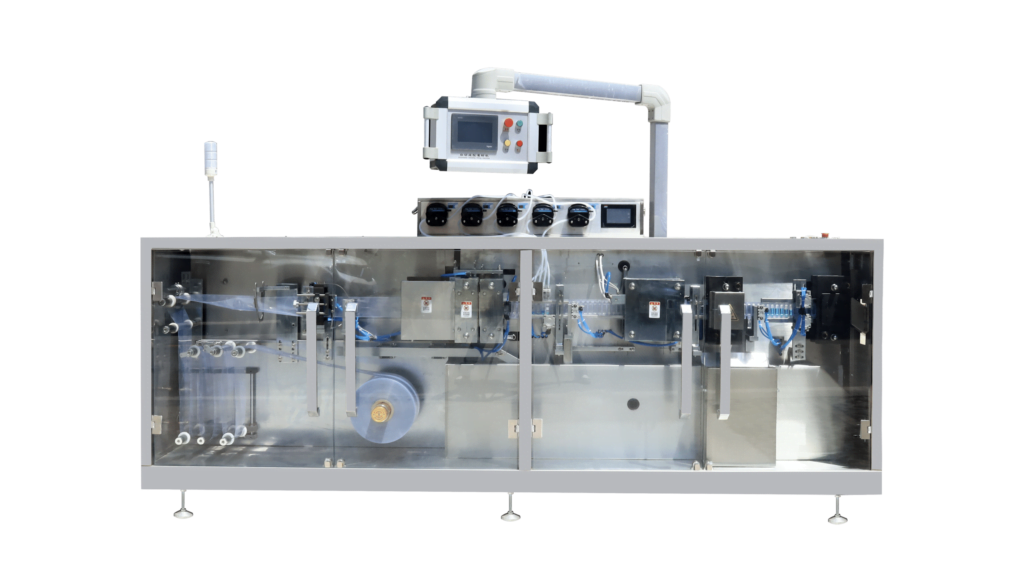
| If you need… | Choose… | Because… |
|---|---|---|
| Small batch / clinical trial (< 50,000 units/day) | Semi-auto flat-plate | Low investment ($2K–$12K), fast format changeover |
| Medium pharma (50K–200K units/day) | Automatic flat-plate | Balanced speed and cost |
| High-volume (> 200K units/day) | Automatic rotary | Continuous motion, 200–400+ blisters/min |
| Moisture-sensitive drugs (WVTR < 0.05) | ALU-ALU cold forming | Complete barrier: light, moisture, oxygen |
| EU market entry | Mono-material PVC thermoforming | PPWR Grade A–B recyclability |
| Food/confectionery | Food blister machine | Food-grade materials, lower GMP requirement |
The Bigger Picture
This isn’t just about buying a blister machine.
It’s about recognizing that the $15,000–150,000 you spend today locks you into a material strategy for the next decade. PPWR is real. Your competitors are asking the mono-material question. Your buyers in the EU will start screening for recyclability claims within 2–3 years.
The right question isn’t “which machine should I buy?” It’s:
“Will this machine still be making compliant products in 2035?”
Find the Right Packaging Machine
See what packaging solutions work for your product type and production scale.
- ✓ Machine type for your product
- ✓ Packaging format options
- ✓ Production capacity match
- ✓ Industry-specific considerations
What To Do From Here
If you know your product’s stability profile, you’re already ahead of 80% of buyers I’ve spoken with. The next step is matching that profile to a forming method, then picking speed based on actual — not aspirational — output.
Or if you’d rather talk through your specific product specs with someone who’s done this a few hundred times:

 English
  Spanish
  Russian
  Korean
  French
  German
  Italian
  Arabic
  Thai
Thai  Chinese
  Vietnamese
  Japanese
  Portuguese
  Dutch
Dutch  Malay
Malay