
The Growing Demand for Efficient Liquid Soap Packaging
Planning a liquid & sauce packaging line? Get a complete line recommendation — from filling to cartoning — in minutes.
Build Your Liquid & Sauce Packaging Line →The global personal care market continues to expand rapidly, and liquid soap has become the dominant format across hand wash, dish soap, and shower gel categories. Behind every well-presented bottle or pouch is a carefully engineered liquid soap packing solution — one that protects product integrity, reinforces brand identity, and keeps production lines running efficiently.
According to market research reports, the global liquid soap market is expected to exceed $40 billion by 2030, driven by increasing hygiene awareness and the shift toward convenient liquid formats.
As packaging experts at Meyers note, packaging is far more than a container: it is the first physical interaction a consumer has with your brand. A well-designed liquid soap package communicates quality, builds trust, and drives repeat purchases. For manufacturers, however, achieving that result consistently requires overcoming real technical challenges — including high viscosity filling, foam generation, leakage control, hygiene compliance, and shelf-life preservation.
Whether you are launching a new soap line or scaling an existing operation, understanding your packaging options and machine requirements is the critical first step.
Major Types of Liquid Soap Packaging
Choosing the right liquid soap packaging format affects not only how your product looks on shelf, but also your filling speed, material cost, and sustainability profile. Here are the four primary formats used in the industry today.

Plastic Bottles — The Most Popular Retail Packaging
PET and HDPE bottles with pump dispensers remain the most widely used format for retail liquid soap. They are durable, brand-friendly, and compatible with a broad range of filling equipment. Their rigid structure provides excellent shelf presence, making them the preferred choice for hand wash, dish soap, and shower gel products.
Pump dispensers in particular add a hygienic, no-touch experience that consumers expect in both retail and hospitality settings. HDPE bottles are favored for their chemical resistance, while PET bottles offer superior clarity — useful for showcasing premium, color-enhanced formulations.
Best for: Retail, supermarket shelves, branded consumer goods, hospitality amenities.
Stand-Up Pouches — Flexible Refill Packaging
Stand-up pouches — including doypacks, spout pouches, and refill pouches — are among the fastest-growing liquid soap packaging formats globally. Their flexible structure uses up to 80% less plastic than traditional rigid bottles, significantly reducing both material cost and shipping weight.
Refill pouches in particular align with the growing consumer demand for sustainable alternatives. Brands that offer a durable pump bottle paired with a refill pouch are capturing a new generation of environmentally conscious buyers — while simultaneously improving margin efficiency. Flexible pouch packaging is not only an eco choice; it is increasingly a competitive differentiator.
Best for: Refill programs, e-commerce, sustainable brand positioning, export markets.
Sachet Packaging — Small Dose Liquid Soap
Sachets (typically 5–30 ml) serve a distinct but high-volume market: hotels, travel products, promotional samples, and single-use applications. Their small format requires high-speed packaging equipment but delivers low per-unit cost at scale.
Liquid soap sachets are especially popular in the hospitality sector across Southeast Asia, the Middle East, and Africa. For manufacturers, sachet lines also offer the flexibility to run product trials and sampling campaigns without committing to full-size packaging inventory.
Best for: Hotels, travel retail, promotional sampling, emerging market distribution.
Carton-Based Liquid Packaging — Eco-Friendly Alternative
Paper-based liquid cartons represent an emerging frontier in sustainable soap packaging. Inspired by the success of carton formats in food and beverage, brands in the personal care space are beginning to explore gable-top and aseptic carton formats as alternatives to plastic bottles.
These containers are made from renewable, recyclable materials and can significantly reduce a brand’s plastic footprint. While still a niche format for liquid soap, carton-based packaging is gaining traction among premium and eco-positioning brands seeking to differentiate on sustainability credentials.
Best for: Premium eco brands, sustainability-focused retail, B2B institutional supply.
Key Challenges in Liquid Soap Packaging
This is an area most competitors overlook — but it is exactly where manufacturers need practical guidance. Understanding these challenges upfront helps you select the right equipment and avoid costly production errors.
High Viscosity Filling
Thick liquid soaps and gel formulations do not flow freely through standard filling nozzles. High viscosity products require equipment specifically designed to handle slow-moving liquids without sacrificing fill accuracy or speed.
Solution: Piston fillers and servo-driven pump filling systems are the industry standard for viscous liquid soap. Piston fillers use a mechanical displacement mechanism to deliver precise volumes regardless of product thickness — making them ideal for creamy, gel, or lotion-type formulations.
Foam Generation
Liquid soap naturally generates foam when agitated — which is a problem during high-speed filling operations. Foam in the fill head creates air pockets, reduces fill accuracy, and contaminates sealing surfaces.
Solution: Bottom-up filling technology (where the nozzle fills from the bottom of the container upward) dramatically reduces foam formation. Anti-foam nozzle designs and controlled fill speeds provide additional protection in high-output environments.
Leakage and Seal Quality
Poor sealing is one of the most common causes of product waste, customer complaints, and returned shipments in liquid soap packaging. Whether you are sealing pouches or capping bottles, precision is non-negotiable.
Solution: Servo-controlled sealing systems with adjustable temperature and pressure settings ensure consistent seal integrity across production runs. For bottle lines, torque-controlled capping machines eliminate both under-tightening (leakage) and over-tightening (cap damage).
Liquid Soap Packaging Machines
The right machine is the backbone of your liquid soap packing solution. Here is a breakdown of the three primary machine types used in the industry.
Vertical Form Fill Seal Machines (VFFS)
VFFS machines automatically form bags from a roll of flat film, fill them with liquid soap, and seal them — all in one continuous operation. They are the workhorse of high-speed sachet and small pouch production, delivering low per-unit packaging costs at volumes from 30 to 120 bags per minute.
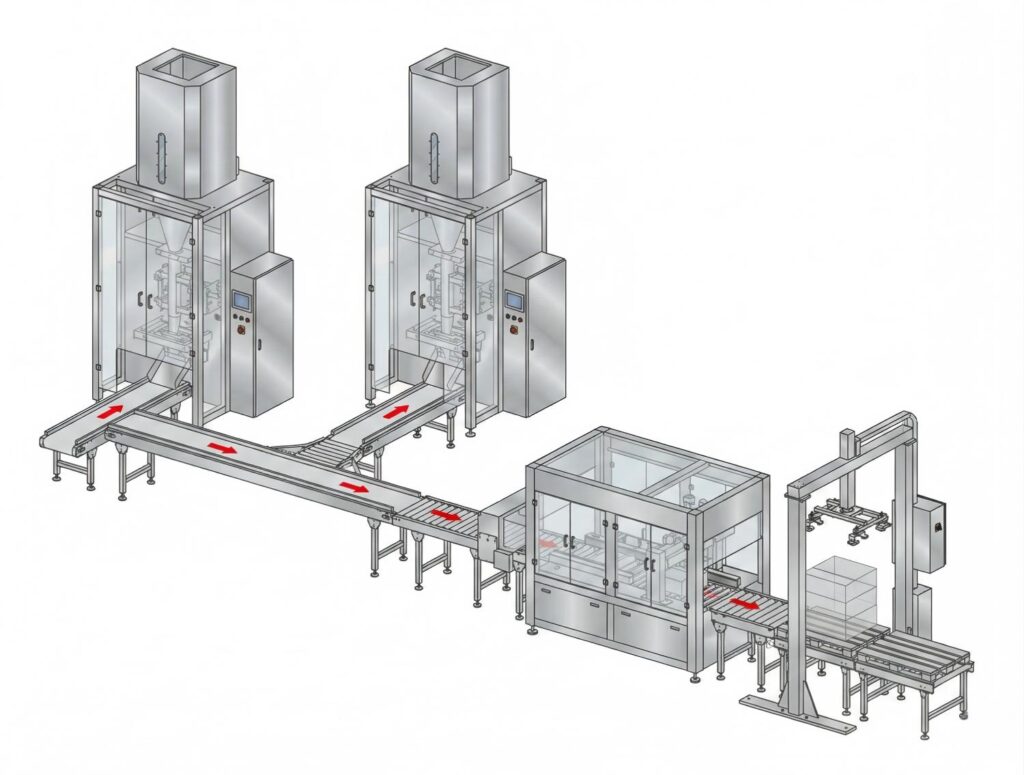
VFFS machines are particularly well-suited for sachets and single-serve formats. Their compact footprint and low film cost make them an attractive entry point for manufacturers targeting the hospitality or travel retail segment. Explore Lintyco’s VFFS machine range →
Premade Pouch Packing Machines
For brands requiring premium flexible packaging — doypacks, spout pouches, or zip-lock refill pouches — premade pouch packing machines deliver superior seal quality and presentation consistency compared to VFFS systems.

These machines accept pre-manufactured pouches (your chosen shape, material, and print) and then automatically open, fill, and seal each unit. The result is a finished package that looks retail-ready straight off the line, with minimal defect rates. For liquid soap refill pouches specifically, spout pouch filling machines offer fully automated spout insertion, filling, and capping in one integrated process.
Thinking about flexible packaging for your liquid soap line? Lintyco’s premade pouch packing machines are engineered for doypacks, spout pouches, and refill formats — with customizable fill volumes and easy-clean stainless steel construction.
Bottle Filling and Capping Lines

A standard liquid soap bottle filling line integrates four core stations:
- Bottle unscrambler — orients and feeds bottles automatically
- Liquid filling machine — delivers precise fill volumes (piston or pump type, depending on viscosity)
- Capping machine — applies and torques pump or screw caps
- Labeling machine — applies front/back or wraparound labels
This modular architecture allows manufacturers to start with essential stations and expand capacity as production volume grows. Lines can be configured for PET, HDPE, glass, or multi-material bottle formats.
Complete Liquid Soap Packing Line Setup
Your production scale determines your optimal line configuration. Here is a practical guide:
Small Production Lines — Startups & Small Brands
- Semi-automatic liquid filler (manual bottle placement)
- Manual or semi-auto capping
- Tabletop labeling machine
- Output: 10–20 bottles/min
- Best for: Startup brands, contract fillers, product testing
This configuration minimizes capital investment while establishing a professional production process. It is scalable — most equipment at this tier can be integrated into a larger automated line as volume demands grow.

Medium Factory Lines — Growing Manufacturers
- Automatic piston or pump liquid filler
- Automatic capper with torque control
- Inline labeler with registration system
- Output: 30–60 bottles/min
- Best for: Established brands, regional distributors, private label manufacturers
At this tier, automation delivers measurable ROI: reduced labor, consistent fill accuracy, and the throughput needed to meet retailer minimum order quantities reliably.

High-Speed Industrial Lines — Large-Scale Production
- Multi-head rotary filling machine
- Robotic capping and torque verification
- Automatic carton packing system with case sealer
- Output: 100+ bottles/min
- Best for: National brands, contract manufacturers, export-volume producers
High-speed lines at this scale typically integrate with upstream mixing and blending systems and downstream palletizing equipment, creating a fully integrated production environment with minimal manual intervention.
Lintyco Liquid Soap Packing Solutions
Lintyco PACK specializes in custom automatic packaging machines and complete liquid soap packaging lines for manufacturers ranging from startups to large-scale industrial producers.
Our liquid soap solutions cover:
- Liquid soap packaging (bottles, pouches, sachets)
- Detergent and dishwashing liquid packaging
- Shampoo and conditioner packaging
- Hand sanitizer and gel packaging
Recommended equipment for liquid soap:
| Machine Type | Best Application |
|---|---|
| VFFS Machine | Sachets, small bags, high-speed |
| Premade Pouch Packing Machine | Doypacks, spout pouches, refill pouches |
| Pouch Packing Machine | Flexible format packaging |
| Complete Packaging Line | Bottle filling, capping, labeling |
What sets Lintyco apart is the combination of European-quality engineering standards with mid-range investment requirements — making professional-grade packaging automation accessible to brands at every stage of growth. Every line is custom-configured to your product’s viscosity profile, packaging format, and target output speed.
Ready to configure your liquid soap packaging line? Contact Lintyco’s packaging engineers for a no-obligation consultation and line proposal.
Sustainability Trends in Soap Packaging
The liquid soap industry is undergoing a structural shift toward sustainable packaging — driven by both consumer demand and tightening regulatory requirements in Europe, North America, and increasingly in Asia.
The four most significant trends reshaping soap packaging solutions are:
- Refill packaging growth — Pump bottles paired with flexible refill pouches are becoming mainstream, reducing plastic per unit by up to 75%
- Recyclable bottle materials — Brands are transitioning from mixed-material to mono-material PET or HDPE bottles that are compatible with existing recycling infrastructure
- Paper-based liquid cartons — Gable-top and aseptic carton formats are moving from food into personal care as material science improves
- Concentrated soap formulas — Smaller, concentrated formats require less packaging material per wash and reduce shipping carbon footprint
Refill packaging is becoming one of the fastest-growing formats in personal care packaging, with some studies estimating up to 70–80% reduction in plastic usage compared with rigid bottles.
How to Choose the Right Liquid Soap Packing Solution
Selecting the optimal solution comes down to four variables: your packaging format, product viscosity, target output speed, and available budget. Use this framework as your starting point:
| Production Scale | Packaging Format | Recommended Solution |
|---|---|---|
| Startup / Small batch | Bottles or basic pouches | Semi-automatic filling line |
| Medium factory | Bottles + refill pouches | Automatic filling line + pouch machine |
| Large factory | Multi-format | Full integrated packaging line |
Key questions to ask before selecting equipment:
- What is the viscosity range of your liquid soap formulation?
- Will you use rigid bottles, stand-up pouches, sachets, or a combination?
- What is your target output in units per minute?
- Do you need multi-format flexibility (e.g., both bottles and pouches on one line)?
- What is your five-year production volume forecast?
Answering these questions before engaging a machine supplier will save time, prevent costly mismatches, and ensure the equipment you invest in scales with your business.
Build Your Liquid & Sauce Packaging Line
Get a personalized recommendation tailored to your product and production target.
- ✓ Product type and packaging format
- ✓ Production target (bags/min)
- ✓ Line layout + equipment recommendation
- ✓ Capacity estimation + ROI
Conclusion
Liquid soap packaging has evolved far beyond the simple plastic bottle. Today’s manufacturers have access to a diverse range of liquid soap packaging types — from premium stand-up pouches and sustainable carton formats to high-speed sachet lines — each supported by specialized machine solutions engineered to handle the unique challenges of liquid soap production.
The right liquid soap packing solution is not a single machine: it is a complete system aligned with your product, your brand, and your production goals.
Lintyco PACK is ready to help you build it. Contact our packaging team today to discuss your liquid soap packaging requirements and receive a customized line proposal.

 English
  Spanish
  Russian
  Korean
  French
  German
  Italian
  Arabic
  Thai
Thai  Chinese
  Vietnamese
  Japanese
  Portuguese
  Dutch
Dutch  Malay
Malay