
The $200,000 Question Nobody Wants to Answer Wrong
Picture this: Your production floor is buzzing at 7 AM. Three operators are manually feeding bags into your semi-automatic filler, racing against a delivery deadline. One calls in sick. Suddenly, you’re short-staffed, behind schedule, and wondering if that fully automatic line quote sitting on your desk isn’t looking so expensive after all.
We see this scenario play out constantly. The decision between semi-automatic and fully automatic packaging isn’t just about buying equipment—it’s about timing your business growth correctly. Upgrade too early, and you’ve locked up capital that could’ve fueled product development. Wait too long, and you’re hemorrhaging money on overtime while competitors ship faster.
After helping over 500 manufacturers navigate this exact decision, we’ve learned one truth: there’s no universal answer, but there are clear signals when it’s time to move.
Semi-Automatic vs. Fully-Automatic Packaging : Which One Do You Need Right Now?
Choose Semi-Automatic If:
- Your annual production volume is still growing but unpredictable
- You run multiple SKUs with frequent changeovers (15+ per month)
- Your budget is under $100K for packaging equipment
- Labor cost isn’t your biggest pain point yet

Upgrade to Fully Automatic When:
- You’re consistently running overtime to meet regular orders
- Labor costs have grown 30%+ in the last 18 months
- You’ve validated product-market fit and demand is stable
- Quality consistency varies too much between shifts
Most manufacturers hit the upgrade trigger somewhere between 18-36 months after their first semi-automatic installation. The sweet spot? When you notice labor management causing more problems than the machine itself.
Difference Between Semi-automatic and Fully Automatic Packaging
Semi-Automatic Packaging Line
Think of a semi-automatic packing machine as a skilled assistant. It handles the technical stuff—precise weighing, consistent filling, clean seals—while your operators manage product feeding, bag positioning, and quality checks.
The Hidden Advantage: These machines are phenomenally flexible. Switching from 500g bags to 1kg bags? Five minutes. Testing a new product line? No complex reprogramming needed. This adaptability is gold when you’re still figuring out what your market really wants.
Custom Case: A granola startup we worked with runs 22 different SKUs through two semi-automatic weigh-fillers. Their runs average just 800 bags per flavor. A fully automatic line would’ve spent more time in changeover mode than actually running.
Fully Automatic Packaging Line
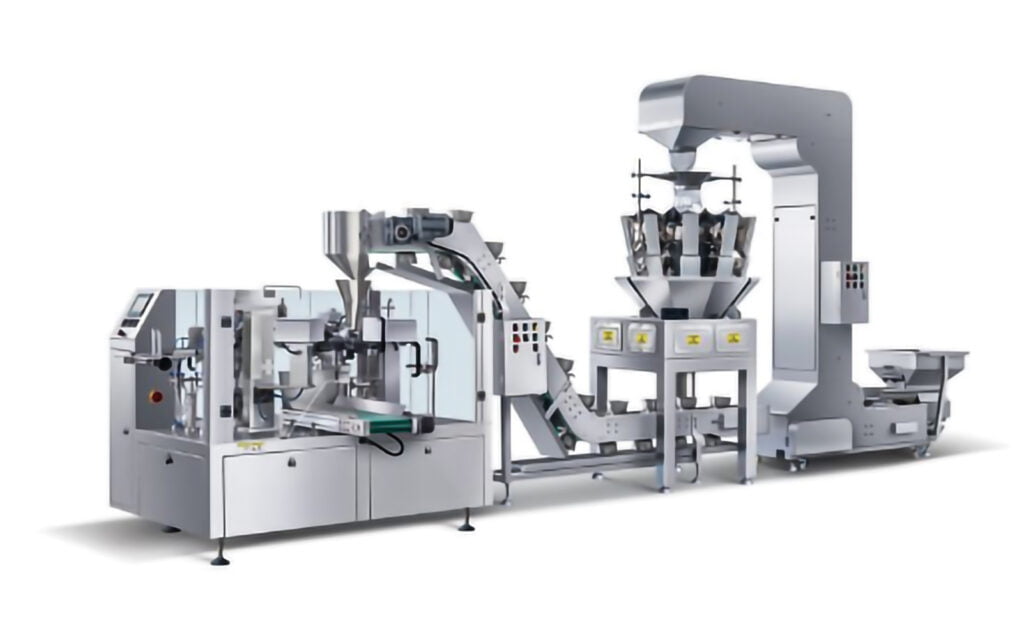
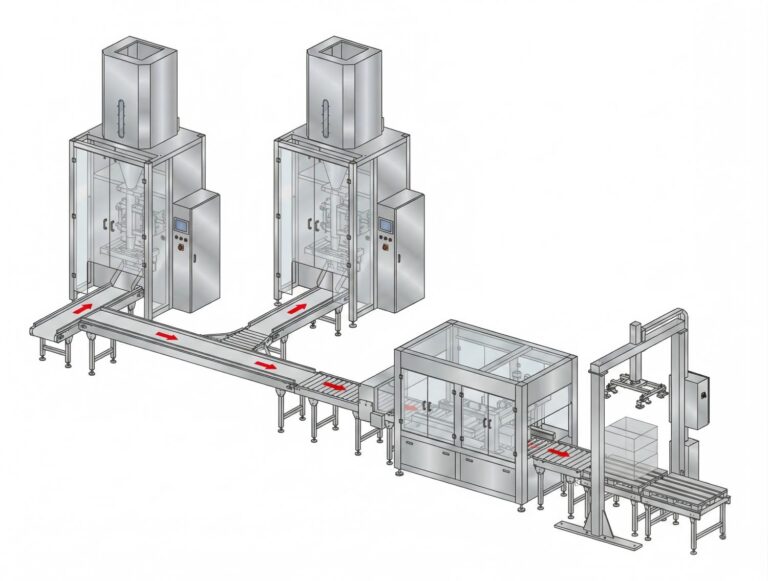
A fully automatic packaging line removes humans from the primary packaging equation. Product flows in one end, finished cases roll out the other. The system runs for hours with minimal supervision.
The Hidden Cost: It’s not just the purchase price. You’re committing to consistent production volumes, longer setup procedures, and a maintenance schedule that requires real technical expertise. Miss your preventative maintenance windows, and a single breakdown can cost you a week of production.
Custom Case: A frozen dumpling manufacturer locked in a national retail contract requiring 20,000 bags daily. Their fully automatic VFFS line with multi-head weighers reduced their packaging team from 8 operators to 1 supervisor. ROI achieved in 14 months—but only because volume was guaranteed.
What Will This Actually Cost You?
Let’s talk numbers, because “total cost of ownership” sounds smart in presentations but feels abstract when you’re signing checks.
Initial Investment Reality Check
| Cost Factor | Semi-Automatic Range | Fully Automatic Range |
|---|---|---|
| Equipment CAPEX | $30,000 – $80,000 | $150,000 – $500,000+ |
| Installation | 1-3 days (minimal) | 2-6 weeks (engineering required) |
| Training Investment | 4-8 hours | 40-80 hours |
| Floor Space Needed | 100-200 sq ft | 400-800 sq ft |
The 3-Year Reality (Example: 10,000 Bags/Day Operation)
Semi-Automatic Scenario:
- Equipment: $60,000
- 3 operators × 2 shifts × $35,000/year = $210,000/year
- Material waste (2-3% from human error): ~$15,000/year
- 3-Year Total: ~$700,000
Fully Automatic Scenario:
- Equipment & Installation: $280,000
- 0.5 operator equivalent × $35,000/year = $17,500/year
- Material waste (0.5% precision control): ~$3,000/year
- Maintenance contracts: ~$12,000/year
- 3-Year Total: ~$380,000
The Gap: $320,000 savings over three years—but only if you maintain that 10,000 bags/day volume consistently. Drop below 6,000 bags/day, and the math flips entirely.
The 5 Signals It’s Time to Upgrade
1. The Overtime Trap
Your operators are working 50+ hour weeks just to meet normal demand. You’re paying time-and-a-half to accomplish what should be standard production.
The Calculation: If overtime costs exceed 15% of your total labor budget for packaging, automation typically pays back within 24 months.
2. The Quality Variance Problem
Monday morning shift produces 99.2% good seals. Friday night shift? 94.8%. That 4.4% difference translates to customer complaints, returns, and damaged brand reputation.
The Signal: If shift-to-shift quality variance exceeds 3%, you’ve outgrown manual oversight.
3. The Hiring Treadmill
You train someone for three weeks. They work for six months. Then they leave. You’re spending 20% of your time recruiting and training packaging operators instead of growing the business.
The Reality: High-turnover packaging positions cost $8,000-$12,000 per replacement when you factor in recruiting, training, and productivity loss.
4. The Space Paradox
You’re out of floor space for more packing tables, but you have room for conveyors. This seems backward, but it’s actually the perfect upgrade signal.
Why It Matters: Fully automatic lines are vertical and linear. They often require less total footprint than multiple manual stations with buffer zones.
5. The Contract Opportunity
A major retailer wants to talk. Their minimum order quantity is 3X your current capacity. You have 60 days to prove you can deliver.
The Truth: This is when smart manufacturers make bold moves. The contract funds the automation.
How to Actually Calculate Your ROI (Not the Consultant Version)
Forget complex spreadsheets. Here’s the back-of-napkin math that actually predicts results:
The Lintyco ROI Framework
Step 1: Calculate Your Annual Labor Cost for Packaging
- Number of operators × Hours per day × Days per year × Hourly rate (including benefits)
- Example: 3 operators × 16 hours × 250 days × $22/hour = $264,000
Step 2: Estimate Labor Savings with Automation
- Fully automatic typically eliminates 70-85% of direct packaging labor
- Example: $264,000 × 0.75 = $198,000 saved annually
Step 3: Add Material Waste Reduction
- Current waste rate × Material cost
- Example: 2.5% waste × $120,000 annual material = $3,000 saved
Step 4: Compare to Equipment Cost
- Total automation investment: $280,000
- Annual savings: $201,000
- Simple payback: 1.4 years
Step 5: Reality Check
- Will you maintain current volume for 3+ years? (If no, recalculate)
- Do you have 6 months of cash runway during installation? (If no, phase the upgrade)
- Can you afford a maintenance contract? (If no, budget $15K/year minimum)
How We Customize Packing Machine For You?
The Coffee Flexible Approach by Semi-automatic
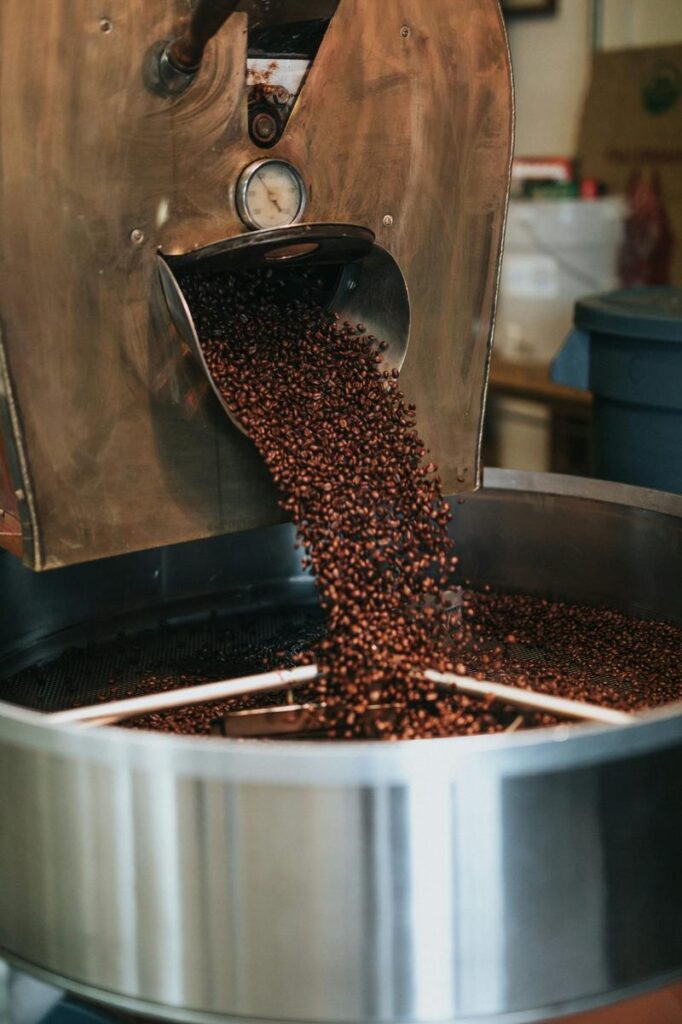
Business: Artisan coffee roaster, 42 SKUs, seasonal demand fluctuations
Initial Situation:
- Producing 2,000-8,000 bags/day depending on season
- High product variety (different origins, roast levels, sizes)
- Limited capital budget ($75K)
Packaging Decision: Two semi-automatic auger fillers with quick-change tooling
Results After 18 Months:
- Maintained flexibility for 15-minute changeovers
- Scaled to 12,000 bags/day during peak season by adding one operator
- When they eventually upgrade to fully automatic, the auger fillers will integrate as modules—zero waste
Sometimes the “slower” choice is actually faster to ROI when your business model demands flexibility.
The Bold Automation For Protein Powder
Business: Contract manufacturer producing protein powder for 3 major brands

Initial Situation:
- Secured 3-year contracts totaling 15,000 bags/day
- Previous semi-automatic setup couldn’t scale
- Quality complaints from retail partners
Packaging Decision: Full VFFS line with twin-head weighers and automatic case packing
Results After 12 Months:
- Reduced packaging labor from 12 operators to 2
- Eliminated 89% of weight complaints (improved accuracy from ±3% to ±0.3%)
- Took on fourth customer contract due to capacity gains
- ROI achieved in 14 months (4 months ahead of projection)
When volume is contracted and guaranteed, aggressive automation beats cautious scaling every time.
Lintyco’s Solutions: Matching Systems to Growth Stages
We’ve engineered packaging lines for operations running 500 bags/day to 50,000+ bags/day. Here’s how we typically recommend matching equipment to business stage:
Stage 1: Market Validation (500-3,000 bags/day)
Recommended: Semi-automatic weigh-filler with manual bag handling
Why: Preserve capital, maintain maximum flexibility, prove product-market fit before committing to fixed automation
Lintyco Solution: Modular semi-automatic systems designed for future integration
Stage 2: Growth & Scaling (3,000-10,000 bags/day)
Recommended: Semi-automatic with automated bag handling OR entry-level VFFS
Why: You’ve proven demand but still need flexibility for product refinement and market expansion
Lintyco Solution: Premade Pouch Packaging Systems for premium presentation with moderate automation
Stage 3: Industrial Scale (10,000+ bags/day)
Recommended: Fully automatic VFFS lines with integrated case packing
Why: Labor costs now exceed equipment costs; consistency and speed are competitive advantages
Lintyco Solution: High-Speed VFFS Lines with multi-head weighers and auto-checkweighing
Stage 4: Multi-Line Operations (Multiple products, 24/7 operation)
Recommended: Multiple fully automatic lines with centralized controls
Why: Operational efficiency, reduced complexity, predictable maintenance
Lintyco Solution: Turnkey integrated systems with unified HMI and remote diagnostics
The Upgrade Implementation Timeline (What Actually Happens)
Most manufacturers underestimate the real timeline for automation upgrades. Here’s the realistic path:
Weeks 1-3: Needs Assessment
- Detailed analysis of current throughput, labor costs, and growth projections
- Floor layout evaluation and utility requirements (power, compressed air, space)
- Product testing with sample materials
Weeks 4-8: Solution Design
- Engineering drawings and line configuration
- Equipment selection and customization specifications
- ROI modeling with your actual numbers
Weeks 9-20: Fabrication (Semi-auto: 2-6 weeks | Fully automatic: 12-20 weeks)
- Machine manufacturing and assembly
- Quality control and pre-shipment testing
- Component sourcing and customization
Weeks 21-24: Installation & Commissioning
- Equipment delivery and installation
- Factory Acceptance Testing at your facility
- Initial operator training
- Line optimization and speed validation
Weeks 25-28: Full Production Ramp
- Operator proficiency development
- Preventative maintenance schedule establishment
- Performance monitoring and fine-tuning
Total Timeline:
- Semi-automatic: 12-16 weeks from decision to full production
- Fully automatic: 24-32 weeks from decision to optimized operation
Common Questions Manufacturers Actually Ask Us
Q: Can I upgrade my semi-automatic machine later instead of buying fully automatic now?
A: Usually, yes—if you plan ahead. The key is specifying “automation-ready” components from day one. For example, an auger filler or multi-head weigher from a semi-automatic station can typically be mounted onto a VFFS bagger later.
At Lintyco, we design modular systems specifically for this upgrade path. You protect your initial investment while maintaining future flexibility.
Q: What happens to my ROI calculation if labor costs increase?
A: Every $1/hour increase in labor costs shortens fully automatic payback by roughly 3-5 months for typical operations. This is why manufacturers in high-wage markets (California, Northeast US, Western Europe) see ROI in 12-18 months while lower-wage regions might see 24-36 months.
Q: How much training do my operators really need?
A: For semi-automatic: 4-8 hours to competency, 40 hours to mastery
For fully automatic: 40 hours initial training, 80+ hours to expert-level troubleshooting
The difference: Semi-automatic operators need physical coordination and quality awareness. Fully automatic operators need mechanical aptitude and diagnostic thinking. Factor this into your hiring profile.
Q: What’s the real maintenance cost nobody talks about?
A: For semi-automatic: ~$2,000-$5,000 annually (mostly consumables and minor repairs)
For fully automatic: ~$12,000-$25,000 annually including:
- Preventative maintenance contracts ($8K-$15K)
- Spare parts inventory ($3K-$8K)
- Unexpected repairs ($1K-$2K)
Budget 5-8% of equipment cost annually for fully automatic maintenance.
Q: How do I know if my product is even suitable for fully automatic packaging?
A: Great question. Some products don’t automate well:
Challenging Products:
- Extremely fragile items requiring gentle handling
- Products with high variability in size/shape
- Sticky or clingy materials that jam sensors
- Items requiring manual quality inspection of every unit
Ideal Products:
- Free-flowing powders and granules
- Consistent-sized pieces or portions
- Stable, non-reactive materials
- Products where weight/volume is the key quality metric
Send us a sample—we’ll run packaging trials and give you honest feedback on automation feasibility.
Automation Is About Timing, Not Technology
The “right” answer isn’t semi-automatic OR fully automatic—it’s semi-automatic THEN fully automatic for most growing manufacturers.
Start semi-automatic if:
- You’re validating products and markets
- Volume is growing but unpredictable
- You need maximum flexibility
- Capital is limited
Upgrade to fully automatic when:
- Demand is validated and stable
- Labor management is constraining growth
- Quality consistency is critical to your brand
- You have the capital and technical capabilities
The manufacturers who succeed don’t just buy machines—they build systems that scale with their business. Sometimes that means starting small and upgrading strategically. Sometimes it means making a bold investment in automation ahead of proven demand.
What matters most is matching the decision to your reality, not someone else’s playbook.
Ready to Calculate Your Specific ROI?
At Lintyco, we’ve helped over 500 manufacturers navigate this exact decision. We don’t push equipment—we help you build a business case that makes sense for your operation.
Get Your Free Consultation:
- Share your current production details
- Receive a customized TCO analysis
- Review equipment options matched to your growth stage
- No obligation, just honest recommendations
Request Your Free Consultation & Quote →

 English
  Spanish
  Russian
  Korean
  French
  German
  Italian
  Arabic
  Thai
Thai  Chinese
  Vietnamese
  Japanese
  Portuguese
  Dutch
Dutch  Malay
Malay